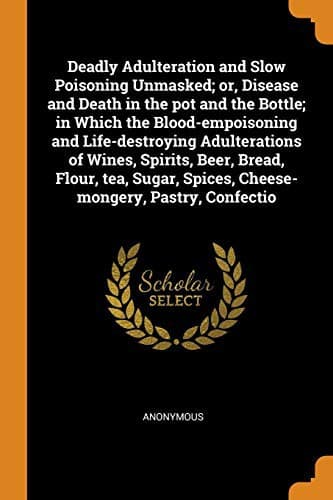
Deadly Adulteration and Slow Poisoning Unmasked: Disease and Death in the Pot and BottleAnonymous
Science
Deadly Adulteration and Slow Poisoning Unmasked: Disease and Death in the Pot and Bottle
Anonymous
Drug adulteration; Food adulteration and inspection
Butter should be bought by the taste and smell. Both fresh and salt
butter should smell sweet, and be of an equal colour throughout; if
veiny and open, it has been mixed with a staler or an inferior sort.
The quality of tub butter is ascertained by putting a knife into the
butter; and if, on drawing it out, any rancid or unpleasant smell
should attach to the knife, the butter is not good; but, perhaps, the
best criterion is to taste the butter near the sides of the tub, for
the middle is often sweet when the parts near the sides of the tub are
quite rank.
Hogs-lard is adulterated with the skimmings of the liquor in which pork
or bacon has been boiled. Lard thus adulterated has a grey colour, a
soft consistence, and a salt taste; whereas lard, when pure, is white,
granular, and rather firm in texture.
CHEESE, BACON, AND HAMS.
When annatto is dear, or of inferior quality in appearance, it is
customary with the venders of the article to adulterate it with
vermilion or red lead. This contamination has chiefly been confined
to the Gloucester cheese; and may be detected by macerating a
small quantity of the suspected article in water impregnated with
sulphuretted hydrogen, acidulated with muriatic acid; which will
immediately cause the cheese to assume a brown or black colour, if the
minutest portion of lead be present. I am informed by a respectable
dealer, that cheese, especially old Stilton cheese, is frequently
_greened_ in particular parts with verdigris, in order to assume the
appearance of age.
The best cheese is that which is of a dry compact texture, without
holes in it; of a whitish colour, and which, on being rubbed between
the finger and thumb, almost immediately becomes a soft and somewhat
greasy mass. Nor is a moist smooth coat a bad criterion of its quality.
It should also be of a moderate age; for neither very decayed, nor
decaying cheese, is wholesome; nor is that which is new, adhesive, and
ropy, when heated by the fire, of a good kind. Cheshire cheese which
crumbles and tastes bitterish has been made of bad milk. Though cheese
is generally chosen by the taste, this is by no means a criterion of
its nutritive qualities; as the flavour generally depends on the nature
of the food which the cows eat, and often on the mode of management in
the manufacture of the cheese.
In the purchase of bacon and hams, pray bear in mind, friend John, that
many more thousands of tons of those articles are sold annually in the
metropolis of this land of “_just and equal dealing_” as “fine, new
Hampshire bacon and fine Yorkshire hams,” than are received from those
counties altogether; and that though the bacon merchants are supplied
with bacon from Ireland, none sell _Irish_ bacon. The large Irish hams
are also dried and sold for “fine fresh” Yorkshire or Westmoreland
varieties, to tickle the fancy of the “Bull Family” for rarities and
expensive purchases.
MILK AND CREAM.
Public-domain text, read in full here on John Shaqi.
Reviews
Reviews
No reviews yet
Be the first to share your thoughts on this work.
Elsewhere in the archive
Join the Discussion
Join the discussion
Sign in to leave a comment or review.
Sign InorCreate an account