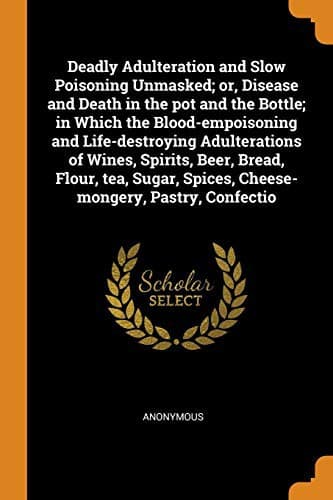
Deadly Adulteration and Slow Poisoning Unmasked: Disease and Death in the Pot and BottleAnonymous
Science
Deadly Adulteration and Slow Poisoning Unmasked: Disease and Death in the Pot and Bottle
Anonymous
Drug adulteration; Food adulteration and inspection
This commodity is subject to much adulteration by the manufacturer.
When good, it is dry, easily reducible to powder, tasteless, and
without odour. In its use in the laundry, there is no good housewife
but can distinguish, by its effects on her “lavatory occupations,” the
difference between good and bad starch: it is therefore unnecessary to
detail tests.
BEES’ WAX.
Bees’ wax is frequently adulterated with rosin, tallow, pease-meal,
potatoe-starch, and a mixture of oil and litharge. The introduction
of rosin into it may be discovered by its hardness, brittleness, and
want of tenacity. When adulterated with tallow, the fraud may be
detected by scratching the finger over the surface; when its clamminess
and adhesiveness to the fingers will indicate the presence of that
ingredient. In the purchase of cakes of bees’ wax the cake should
be broke, in order to ascertain whether the impurities called foot,
are not ingeniously _encased_ in a shell of pure wax. White wax is
adulterated with carbonate of lead and white tallow, to increase its
weight.
Bees’ wax, when good, is of a compact substance, somewhat unctuous
to the touch, but not adhering to the fingers or to the teeth when
it is kneaded or chewed: and when scratched by the finger-nail, no
obstruction is met with, and but little indentation or fissure made; it
also has an agreeable smell partaking of a slight odour of honey, and a
clear fresh yellow colour. Its texture is also granular.
SECTION VI.
_Butter, Cheese, Milk, Cream, and Potatoes._
BUTTER.
Butter is not exempt from adulteration: the inferior kinds are
frequently mixed up with hogs-lard which has lost its flavour and
appearance; and not unfrequently kitchen-stuff forms a portion of the
bulk.
Good butter is hard and firm; therefore that butter which is often sold
in the shops in London, that adheres to the knife when applied to, or
stuck into it, is factitious, that is, manufactured in a machine, of
the following materials—viz. rancid fresh butter, the cheap unsaleable
Scotch butters of various hues and dyes, and a quantity of salt,
well rummaged and pomelled together. This spurious commodity is of a
white cast, and generally sold under the denomination of “Dorset.”
It should be recollected that the cheesemongers never beat the good
butters, as the beating injures the flavour; they bestow their friendly
castigations only on the worthless commodity for the purpose of
extracting a portion of its rancidity and obnoxious smell.
Public-domain text, read in full here on John Shaqi.
Reviews
Reviews
No reviews yet
Be the first to share your thoughts on this work.
Elsewhere in the archive
Join the Discussion
Join the discussion
Sign in to leave a comment or review.
Sign InorCreate an account