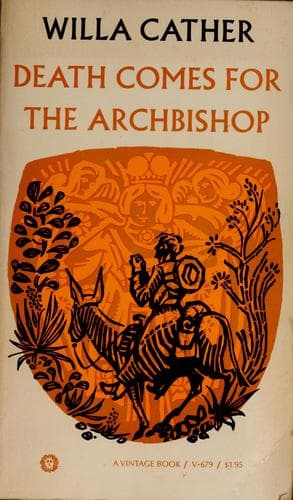
Christian fiction; Clergy -- Fiction; Historical fiction; New Mexico -- Fiction
Bernard understood. He knew that once, long ago, at that hour of the
day, a young Bishop had ridden along the Albuquerque road and seen Santa
Fé for the first time... And often, when they were driving into town
together, the Bishop had paused with Bernard on that hill-top from which
Father Vaillant had looked back on Santa Fé, when he went away to
Colorado to begin the work that had taken the rest of his life and made
him, too, a Bishop in the end.
The old town was better to look at in those days, Father Latour used to
tell Bernard with a sigh. In the old days it had an individuality, a
style of its own; a tawny adobe town with a few green trees, set in a
half-circle of carnelian-coloured hills; that and no more. But the year
1880 had begun a period of incongruous American building. Now, half the
plaza square was still adobe, and half was flimsy wooden buildings with
double porches, scroll-work and jackstraw posts and banisters painted
white. Father Latour said the wooden houses which had so distressed him
in Ohio, had followed him. All this was quite wrong for the Cathedral
he had been so many years in building,--the Cathedral that had taken
Father Vaillant's place in his life after that remarkable man went away.
Father Latour made his last entry into Santa Fé at the end of a
brilliant February afternoon; Bernard stopped the horses at the foot of
the long street to await the sunset.
Wrapped in his Indian blankets, the old Archbishop sat for a long while,
looking at the open, golden face of his Cathedral. How exactly young
Molny, his French architect, had done what he wanted! Nothing
sensational, simply honest building and good stone-cutting,--good Midi
Romanesque of the plainest. And even now, in winter, when the acacia
trees before the door were bare, how it was of the South, that church,
how it sounded the note of the South!
No one but Molny and the Bishop had ever seemed to enjoy the beautiful
site of that building,--perhaps no one ever would. But these two had
spent many an hour admiring it. The steep carnelian hills drew up so
close behind the church that the individual pine trees thinly wooding
their slopes were clearly visible. From the end of the street where the
Bishop's buggy stood, the tawny church seemed to start directly out of
those rose-coloured hills--with a purpose so strong that it was like
action. Seen from this distance, the Cathedral lay against the
pinesplashed slopes as against a curtain. When Bernard drove slowly
nearer, the backbone of the hills sank gradually, and the towers rose
clear into the blue air, while the body of the church still lay against
the mountain.
Public-domain text, read in full here on John Shaqi.
Reviews
Reviews
No reviews yet
Be the first to share your thoughts on this work.
Elsewhere in the archive
Join the Discussion
Join the discussion
Sign in to leave a comment or review.
Sign InorCreate an account