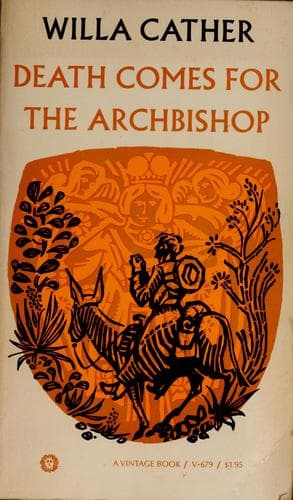
Christian fiction; Clergy -- Fiction; Historical fiction; New Mexico -- Fiction
He loved the towering peaks of his native mountains, the comeliness of
the villages, the cleanness of the country-side, the beautiful lines and
the cloisters of his own college. Clermont was beautiful,--but he found
himself sad there; his heart lay like a stone in his breast. There was
too much past, perhaps... When the summer wind stirred the lilacs in the
old gardens and shook down the blooms of the horsechestnuts, he
sometimes closed his eyes and thought of the high song the wind was
singing in the straight, striped pine trees up in the Navajo forests.
During the day his nostalgia wore off, and by dinner-time it was quite
gone. He enjoyed his dinner and his wine, and the company of cultivated
men, and usually retired in good spirits. It was in the early morning
that he felt the ache in his breast; it had something to do with waking
in the early morning. It seemed to him that the grey dawn lasted so long
here, the country was a long while in coming to life. The gardens and
the fields were damp, heavy-mists hung in the valley and obscured the
mountains; hours went by before the sun could disperse those vapours and
warm and purify the villages.
In New Mexico he always awoke a young man; not until he rose and began
to shave did he realize that he was growing older. His first
consciousness was a sense of the light dry wind blowing in through the
windows, with the fragrance of hot sun and sagebrush and sweet clover; a
wind that made one's body feel light and one's heart cry "To-day,
to-day," like a child's.
Beautiful surroundings, the society of learned men, the charm of noble
women, the graces of art, could not make up to him for the loss of those
light-hearted mornings of the desert, for that wind that made one a boy
again. He had noticed that this peculiar quality in the air of new
countries vanished after they were tamed by man and made to bear
harvests. Parts of Texas and Kansas that he had first known as open
range had since been made into rich farming districts, and the air had
quite lost that lightness, that dry aromatic odour. The moisture of
plowed land, the heaviness of labour and growth and grain-bearing,
utterly destroyed it; one could breathe that only on the bright edges of
the world, on the great grass plains or the sage-brush desert.
That air would disappear from the whole earth in time, perhaps; but long
after his day. He did not know just when it had become so necessary to
him, but he had come back to die in exile for the sake of it. Something
soft and wild and free, something that whispered to the ear on the
pillow, lightened the heart, softly, softly picked the lock, slid the
bolts, and released the prisoned spirit of man into the wind, into the
blue and gold, into the morning, into the morning!
4
Public-domain text, read in full here on John Shaqi.
Reviews
Reviews
No reviews yet
Be the first to share your thoughts on this work.
Elsewhere in the archive
Join the Discussion
Join the discussion
Sign in to leave a comment or review.
Sign InorCreate an account