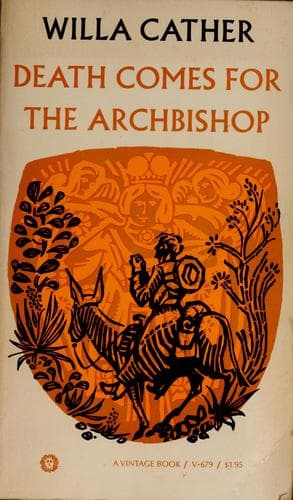
Christian fiction; Clergy -- Fiction; Historical fiction; New Mexico -- Fiction
In the late afternoon of the following day the Bishop was walking alone
along the banks of the life-giving stream, reviewing in his mind the
events of the morning. Benito and his daughter had made an altar before
the sorrowful wooden Virgin, and placed upon it candles and flowers.
Every soul in the village, except Salvatore's sick wife, had come to the
Mass. He had performed marriages and baptisms and heard confessions and
confirmed until noon. Then came the christening feast. José had killed
a kid the night before, and immediately after her confirmation Josepha
slipped away to help her sisters-in-law roast it. When Father Latour
asked her to give him his portion without chili, the girl inquired
whether it was more pious to eat it like that. He hastened to explain
that Frenchmen, as a rule, do not like high seasoning, lest she should
hereafter deprive herself of her favourite condiment.
After the feast the sleepy children were taken home, the men gathered in
the plaza to smoke under the great cottonwood trees. The Bishop, feeling
a need of solitude, had gone forth to walk, firmly refusing an escort.
On his way he passed the earthen thrashing-floor, where these people
beat out their grain and winnowed it in the wind, like the Children of
Israel. He heard a frantic bleating behind him, and was overtaken by
Pedro with the great flock of goats, indignant at their day's
confinement, and wild to be in the fringe of pasture along the hills.
They leaped the stream like arrows speeding from the bow, and regarded
the Bishop as they passed him with their mocking, humanly intelligent
smile. The young bucks were light and elegant in figure, with their
pointed chins and polished tilted horns. There was great variety in
their faces, but in nearly all something supercilious and sardonic. The
angoras had long silky hair of a dazzling whiteness. As they leaped
through the sunlight they brought to mind the chapter in the Apocalypse,
about the whiteness of them that were washed in the blood of the Lamb.
The young Bishop smiled at his mixed theology. But though the goat had
always been the symbol of pagan lewdness, he told himself that their
fleece had warmed many a good Christian, and their rich milk nourished
sickly children.
About a mile above the village he came upon the water-head, a spring
overhung by the sharp-leafed variety of cottonwood called water willow.
All about it crowded the oven-shaped hills,--nothing to hint of water
until it rose miraculously out of the parched and thirsty sea of sand.
Some subterranean stream found an outlet here, was released from
darkness. The result was grass and trees and flowers and human life;
household order and hearths from which the smoke of burning piñon logs
rose like incense to Heaven.
Public-domain text, read in full here on John Shaqi.
Reviews
Reviews
No reviews yet
Be the first to share your thoughts on this work.
Join the Discussion
Join the discussion
Sign in to leave a comment or review.
Sign InorCreate an account