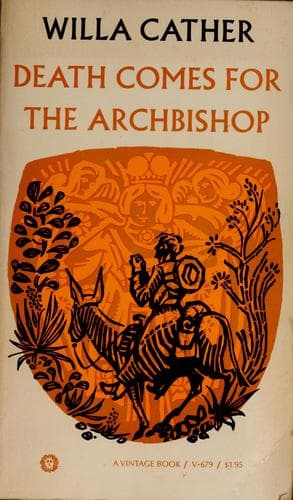
Christian fiction; Clergy -- Fiction; Historical fiction; New Mexico -- Fiction
In 1875 the Bishop took his French architect on a pack trip into Arizona
to show him something of the country before he returned to France, and
he had the pleasure of seeing the Navajo horsemen riding free over their
great plains again. The two Frenchmen went as far as the Canyon de
Chelly to behold the strange cliff ruins; once more crops were growing
down at the bottom of the world between the towering sandstone walls;
sheep were grazing under the magnificent cottonwoods and drinking at the
streams of sweet water; it was like an Indian Garden of Eden.
Now, when he was an old man and ill, scenes from those bygone times,
dark and bright, flashed back to the Bishop: the terrible faces of the
Navajos waiting at the place on the Rio Grande where they were being
ferried across into exile; the long streams of survivors going back to
their own country, driving their scanty flocks, carrying their old men
and their children. Memories, too, of that time he had spent with
Eusabio on the Little Colorado, in the early spring, when the lambing
season was not yet over,--dark horsemen riding across the sands with
orphan lambs in their arms--a young Navajo woman, giving a lamb her
breast until a ewe was found for it.
"Bernard," the old Bishop would murmur, "God has been very good to let
me live to see a happy issue to those old wrongs. I do not believe, as I
once did, that the Indian will perish. I believe that God will preserve
him."
8
THE American doctor was consulting with Archbishop S---- and the Mother
Superior. "It is his heart that is the trouble now. I have been giving
him small doses to stimulate it, but they no longer have any effect. I
scarcely dare increase them; it might be fatal at once. But that is why
you see such a change in him."
The change was that the old man did not want food, and that he slept, or
seemed to sleep, nearly all the time. On the last day of his life his
condition was pretty generally known. The Cathedral was full of people
all day long, praying for him; nuns and old women, young men and girls,
coming and going. The sick man had received the Viaticum early in the
morning. Some of the Tesuque Indians, who had been his country
neighbours, came into Santa Fé and sat all day in the Archbishop's
courtyard listening for news of him; with them was Eusabio the Navajo.
Fructosa and Tranquilino, his old servants, were with the supplicants in
the Cathedral.
The Mother Superior and Magdalena and Bernard attended the sick man.
There was little to do but to watch and pray, so peaceful and painless
was his repose. Sometimes it was sleep, they knew from his relaxed
features; then his face would assume personality, consciousness, even
though his eyes did not open.
Public-domain text, read in full here on John Shaqi.
Reviews
Reviews
No reviews yet
Be the first to share your thoughts on this work.
Elsewhere in the archive
Join the Discussion
Join the discussion
Sign in to leave a comment or review.
Sign InorCreate an account