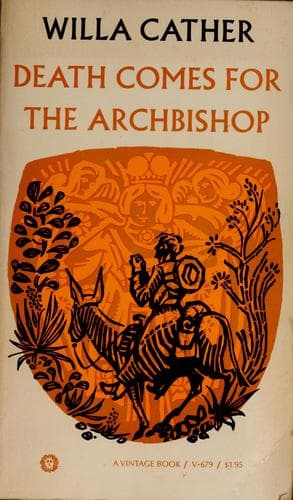
Christian fiction; Clergy -- Fiction; Historical fiction; New Mexico -- Fiction
"_Monseigneur est servi! Alors, Jean, veux-tu apporter les bougies._"
The Bishop carried the candles into the dining-room, where the table was
laid and Father Vaillant was changing his cook's apron for his cassock.
Crimson from standing over an open fire, his rugged face was even
homelier than usual--though one of the first things a stranger decided
upon meeting Father Joseph was that the Lord had made few uglier men. He
was short, skinny, bow-legged from a life on horseback, and his
countenance had little to recommend it but kindliness and vivacity. He
looked old, though he was then about forty. His skin was hardened and
seamed by exposure to weather in a bitter climate, his neck scrawny and
wrinkled like an old man's. A bold, blunt-tipped nose, positive chin, a
very large mouth,--the lips thick and succulent but never loose, never
relaxed, always stiffened by effort or working with excitement. His
hair, sunburned to the shade of dry hay, had originally been
tow-coloured; "_Blanchet_" ("Whitey") he was always called at the
Seminary. Even his eyes were near-sighted, and of such a pale, watery
blue as to be unimpressive. There was certainly nothing in his outer
case to suggest the fierceness and fortitude and fire of the man, and
yet even the thick-blooded Mexican half-breeds knew his quality at once.
If the Bishop returned to find Santa Fé friendly to him, it was because
everybody believed in Father Vaillant--homely, real, persistent, with
the driving power of a dozen men in his poorly built body.
On coming into the dining-room, Bishop Latour placed his candlesticks
over the fire-place, since there were already six upon the table,
illuminating the brown soup-pot. After they had stood for a moment in
prayer, Father Joseph lifted the cover and ladled the soup into the
plates, a dark onion soup with croutons. The Bishop tasted it critically
and smiled at his companion. After the spoon had travelled to his lips a
few times, he put it down and leaning back in his chair remarked,
"Think of it, _Blanchet_; in all this vast country between the
Mississippi and the Pacific Ocean, there is probably not another human
being who could make a soup like this."
"Not unless he is a Frenchman," said Father Joseph. He had tucked a
napkin over the front of his cassock and was losing no time in
reflection.
"I am not deprecating your individual talent, Joseph," the Bishop
continued, "but, when one thinks of it, a soup like this is not the work
of one man. It is the result of a constantly refined tradition. There
are nearly a thousand years of history in this soup."
Father Joseph frowned intently at the earthen pot in the middle of the
table. His pale, near-sighted eyes had always the look of peering into
distance. "_C'est ça, c'est vrai_," he murmured. "But how," he
exclaimed as he filled the Bishop's plate again, "how can a man make a
proper soup without leeks, that king of vegetables? We cannot go on
eating onions for ever."
Public-domain text, read in full here on John Shaqi.
Reviews
Reviews
No reviews yet
Be the first to share your thoughts on this work.
Join the Discussion
Join the discussion
Sign in to leave a comment or review.
Sign InorCreate an account