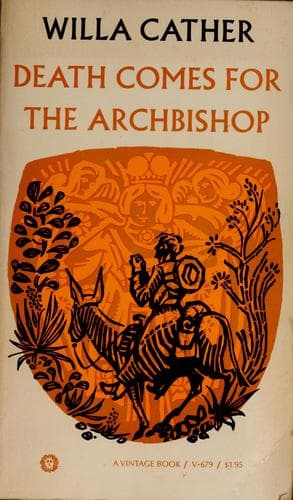
Christian fiction; Clergy -- Fiction; Historical fiction; New Mexico -- Fiction
THE Bishop and his Vicar were riding through the rain in the Truchas
mountains. The heavy, lead-coloured drops were driven slantingly through
the air by an icy wind from the peak. These raindrops, Father Latour
kept thinking, were the shape of tadpoles, and they broke against his
nose and cheeks, exploding with a splash, as if they were hollow and
full of air. The priests were riding across high mountain meadows, which
in a few weeks would be green, though just now they were slate-coloured.
On every side lay ridges covered with blue-green fir trees; above them
rose the horny backbones of mountains. The sky was very low; purplish
lead-coloured clouds let down curtains of mist into the valleys between
the pine ridges. There was not a glimmer of white light in the dark
vapours working overhead--rather, they took on the cold green of the
evergreens. Even the white mules, their coats wet and matted into tufts,
had turned a slaty hue, and the faces of the two priests were purple and
spotted in that singular light.
Father Latour rode first, sitting straight upon his mule, with his chin
lowered just enough to keep the drive of rain out of his eyes. Father
Vaillant followed, unable to see much,--in weather like this his glasses
were of no use, and he had taken them off. He crouched down in the
saddle, his shoulders well over Contento's neck. Father Joseph's sister,
Philomène, who was Mother Superior of a convent in her native town in
the Puy-de-Dôm, often tried to picture her brother and Bishop Latour on
these long missionary journeys of which he wrote her; she imagined the
scene and saw the two priests moving through it in their cassocks,
bare-headed, like the pictures of St. Francis Xavier with which she was
familiar. The reality was less picturesque,--but for all that, no one
could have mistaken these two men for hunters or traders. They wore
clerical collars about their necks instead of neckerchiefs, and on the
breast of his buckskin jacket the Bishop's silver cross hung by a silver
chain.
They were on their way to Mora, the third day out, and they did not know
just how far they had still to go. Since morning they had not met a
traveller or seen a human habitation. They believed they were on the
right trail, for they had seen no other. The first night of their
journey they had spent at Santa Cruz, lying in the warm, wide valley of
the Rio Grande, where the fields and gardens were already softly
coloured with early spring. But since they had left the Española
country behind them, they had contended first with wind and sand-storms,
and now with cold. The Bishop was going to Mora to assist the Padre
there in disposing of a crowd of refugees who filled his house. A new
settlement in the Conejos valley had lately been raided by Indians; many
of the inhabitants were killed, and the survivors, who were originally
from Mora, had managed to get back there, utterly destitute.
Public-domain text, read in full here on John Shaqi.
Reviews
Reviews
No reviews yet
Be the first to share your thoughts on this work.
Join the Discussion
Join the discussion
Sign in to leave a comment or review.
Sign InorCreate an account