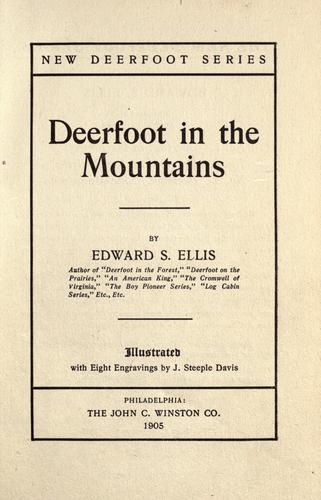
Overland journeys to the Pacific -- Juvenile fiction; Shawnee Indians -- Juvenile fiction; Siksika Indians -- Juvenile fiction
Early as was the season, the men suffered much from mosquitoes. Spring
kept company with the expedition. Herds of deer, elk, buffaloes and
antelopes were seen grazing on the rich grass, and there seemed no end
to swans and geese. Passing the alkali regions, the party reached, in
the latter part of April, the mouth of a large river, to which they
gave the name of Yellowstone. Joseph Fields, of Kentucky, ascended it
for eight miles, and was the first white man to do so. Rains, high
winds and cold weather welcomed them into the hills of Montana, and
often the boats had to be dragged along the banks by means of elk-skin
cords. They were thus laboriously making their way when, as has been
shown, they were met by Deerfoot and the Shelton brothers at the mouth
of the Musselshell River.
The story of the Lewis and Clark expedition, therefore, ended for
George and Victor Shelton at the point named. It will not be
uninteresting, however, to sum up the history of one of the most
memorable enterprises connected with the development of the West.
Captains Lewis and Clark gained a great deal of valuable knowledge from
the boys, who had traversed a large part of the region which they
intended to explore. The excellent memories and the marked intelligence
of the youths were admired by the officers.
A few days after the meeting between the two parties Lewis climbed to
the top of the highest elevation north of the river and gained his
first view of the Rocky Mountains, known at that time as the Stony
Mountains. All the numerous streams were described and named. It has
been charged against the explorers that they were lacking in sentiment
and imagination, for most of the names thus given by them have been
supplanted by others, but it cannot be said that these changes have
always been an improvement.
On the second day of summer the explorers had to face a puzzling
problem. A large branch flowing from the north was so similar to the
Missouri that it seemed it must be that river, while the one hitherto
accepted as such bore to the south. Which was the branch that,
according to the reports of the Indians, had its rise in the Rocky
Mountains, near the source of the Columbia? To settle the question the
party divided, one ascending either branch. Upon reuniting it was
agreed that the south branch was the real Missouri. The northern stream
was named the Maria. This was another of the few instances in which the
title given by the explorers stuck.
The rapids five miles below the Falls of the Missouri were reached on
June 15. These had to be passed by a portage. An idea can be formed of
the great difficulties encountered when it is stated that, although the
portage was hardly eighteen miles long, it took eleven days to make it.
The men, however, were in high spirits, and at night Peter Cruzatte
added to the "gayety of nations" by playing on his violin.
Public-domain text, read in full here on John Shaqi.
Reviews
Reviews
No reviews yet
Be the first to share your thoughts on this work.
Elsewhere in the archive
Join the Discussion
Join the discussion
Sign in to leave a comment or review.
Sign InorCreate an account