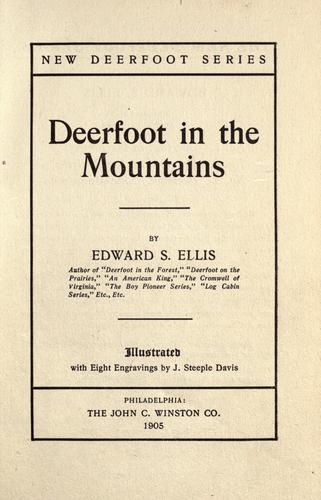
Overland journeys to the Pacific -- Juvenile fiction; Shawnee Indians -- Juvenile fiction; Siksika Indians -- Juvenile fiction
For a time the expedition acted the part of peacemaker among the
Indians. The officers patched up peace agreements between the tribes
that were on the verge of warfare, and made treaties with the Yankton
branch of the Sioux and the Ricaras. All these natives were familiar
with white men, having known both French traders and the employees of
the British Fur Company. The Indians showed a friendly disposition
toward the explorers, but their wonder was unbounded at sight of the
African servant, he being the first of his race they had ever seen.
With the waggery of his nature this negro gravely informed them that he
was really a wild animal that had been caught and tamed. The simple
folk believed his fantastic yarns, which were emphasized by numerous
feats of strength on his part.
Progress up the river was slow, because of the many sand bars and
numerous curves of the stream. The hunters, who kept in advance,
secured large quantities of fresh meat, and dried a good deal for the
winter supply. The region of the Mandans was reached in the latter part
of October. There a fort was built and occupied during the winter. This
was in what is now McLean County, North Dakota. The winter was very
severe, and many of the men had their hands and feet frostbitten, while
the continual glare of the snow caused a temporary blindness.
At this fort another interpreter was engaged. He was a Canadian, whose
wife was a member of the Snake tribe of Indians of the Rocky Mountains.
She was stolen when a child and brought east, where she was bought by
the Canadian, who made her his wife. She was a remarkable woman, and
the only one of her sex who accompanied the party. When she set out she
carried an infant barely two months old. She not only stood the journey
as well as any of the men, but displayed a rare degree of intelligence.
She remembered much of the wild region through which the party had to
pass, and smoothed the way among her own race for the white invaders.
She became very popular with all the members, and deserved the praise
which the leaders gave her.
Six canoes were soon completed. The company made their start April 7,
1805, sixteen going down stream with a barge laden with curiosities of
the region for President Jefferson, while thirty-two formed the
permanent party, which pressed into the great unknown region spreading
out before them. The names of all these explorers are preserved in the
archives of the War Department under the title of "A roll of the men
who accompanied Captains Lewis and Clark on their late tour to the
Pacific Ocean through the interior of the continent of North America,
showing their rank, with some remarks on their respective merits and
services."
Public-domain text, read in full here on John Shaqi.
Reviews
Reviews
No reviews yet
Be the first to share your thoughts on this work.
Elsewhere in the archive
Join the Discussion
Join the discussion
Sign in to leave a comment or review.
Sign InorCreate an account