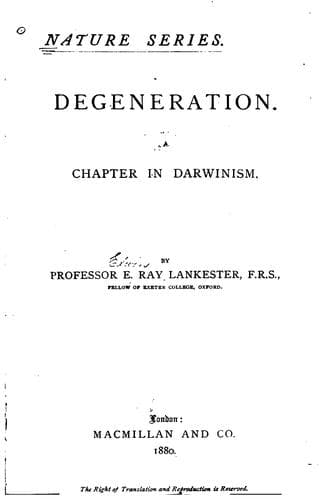
Degeneration: A Chapter in DarwinismLankester, E. Ray (Edwin Ray), Sir
Science
Degeneration: A Chapter in Darwinism
Lankester, E. Ray (Edwin Ray), Sir
Degeneration; Evolution (Biology)
No one ventures to deny, at the present day, that every human being
grows from the egg _in utero_, just as a dog or a monkey does; the
facts are before us and can be scrutinised in detail. We may ask of
those who refuse to admit the gradual and natural development of man’s
consciousness in the ancestral series, passing from ape-like forms into
indubitable man, “How do you propose to divide the series presented by
every individual man in his growth from the egg? At what particular phase
in the embryonic series is the soul with its potential consciousness
implanted? Is it in the egg? in the fœtus of this month or of that? in
the new-born infant? or at five years of age?” This, it is notorious,
is a point upon which Churches have never been able to agree; and it is
equally notorious that the unbroken series exists—that the egg becomes
the fœtus, the fœtus the child, and the child the man. On the other
hand we have the historical series—the series, the existence of which
is inferred by Darwin and his adherents. This is a series leading from
simple egg-like organisms to ape-like creatures, and from these to man.
Will those who cannot answer our previous inquiries undertake to assert
dogmatically in the present case at what point in the historical series
there is a break or division? At what step are we to be asked to suppose
that the order of nature was stopped, and a non-natural soul introduced?
The philosopher or theologian of this or that school may arbitrarily draw
an imaginary line here or there in either series, and the evolutionist
will not raise a finger to stop him. As long as truth in the statement of
fact, and logic in the inference from observed fact are respected, there
need be no hostility between evolutionist and theologian. The theologian
is content in the case of individual development from the egg to admit
the facts of individual evolution, and to make assumptions which lie
altogether outside the region of scientific inquiry. So, too, it would
seem only reasonable that he should deal with the historical series,
and frankly accept the natural evolution of man from lower animals,
declaring dogmatically, if he so please, but not as an inference of the
same order as are the inferences of science, that something called the
soul arrived at any point in the series which he may think suitable. At
the same time, it would appear to be sufficient, even for the purposes of
the theologian, to hold that whatever the two above-mentioned series of
living things contain or imply, they do so as the result of a natural and
uniform process of development, that there has been one “miracle” once
and for all time. It should not be a ground of offence to any school of
thinkers, that Darwinism, whilst leaving them free scope, cannot be made
actually contributory to the support of their particular tenets.
Public-domain text, read in full here on John Shaqi.
Reviews
Reviews
No reviews yet
Be the first to share your thoughts on this work.
Join the Discussion
Join the discussion
Sign in to leave a comment or review.
Sign InorCreate an account