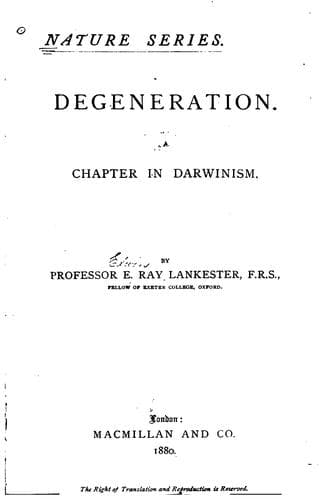
Degeneration: A Chapter in DarwinismLankester, E. Ray (Edwin Ray), Sir
Science
Degeneration: A Chapter in Darwinism
Lankester, E. Ray (Edwin Ray), Sir
Degeneration; Evolution (Biology)
The result of super-larvation is in so far similar to that of those
changes to which it is desirable to restrict the term “degeneration,”
that it may be classed under “simplificative evolution” as opposed to
“elaborative evolution.” That there is a very real difference between
super-larvation and degeneration may best be seen by taking a case of
each process and instituting a comparison. Axolotl proceeds regularly
on its course of development from the egg, but instead of passing from
the aquatic gilled condition to the terrestrial gill-less adult form of
the Salamander, it remains arrested in the earlier condition, develops
its reproductive organs, and propagates itself. There is no loss or
atrophy in this case, but simply a dead stop in a progressive course.
On the other hand, as we have seen, the Ascidian loses, by a process of
atrophy and destruction, a powerful locomotive organ, a highly-developed
eye, a relatively large nervous system. The former may be compared to
a permanent childishness, the latter to the second childhood, which is
really atrophy and decay. It is highly probable that super-larvation
has taken place at various epochs and in various groups of the animal
kingdom, just as it does in axolotl, and yet we cannot hope for evidence
fitted to establish its occurrence in any one case, where it is no
longer possible by exceptional conditions to recover (as in the case of
axolotl, which can experimentally be made to advance to the Salamander
phase by proper treatment), the discarded, more developed adult form.
By super-larvation it would be possible for an embryonic form developed
in relation to special embryonic conditions and not recapitulative of
an ancestry, to become the adult form of the race, and thus to give to
the subsequent evolution of that race a totally and otherwise improbable
direction.
It seems also exceedingly probable that “super-larvation” does not occur
only as in axolotl through premature maturation of the reproductive
organs, but the phenomenon _may_ develop itself more slowly by a gradual
creeping forward, as it were, of larval features. Just as the adaptations
acquired in, and having relation to, later life tend to show themselves
in an early period of the development of the individual and out of
due season; so do characters acquired by the early embryo, and having
relation only to this early period of life tend to remain as permanent
structures, and by their invasion to perturb the adult organization. Such
perturbation may tend _either_ to simplification or elaboration.
D.
Public-domain text, read in full here on John Shaqi.
Reviews
Reviews
No reviews yet
Be the first to share your thoughts on this work.
Join the Discussion
Join the discussion
Sign in to leave a comment or review.
Sign InorCreate an account