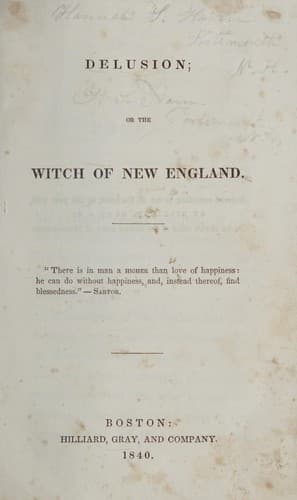
Delusion; or, The Witch of New EnglandLee, Eliza Buckminster
History
Delusion; or, The Witch of New England
Lee, Eliza Buckminster
Paranormal fiction; Salem (Mass.) -- History -- Colonial period, ca. 1600-1775 -- Fiction; Witchcraft -- New England -- Fiction
Edith told her the lamp had been extinguished with the wind.
"Alas!" she said; "and I must die as I have lived,--in darkness."
Edith assured her she was not then dying, and begged her to try to pray,
or to listen while she endeavored, as far as she was able, to offer a
prayer to God.
"No," she said; "I have lived without prayer, and I will not mock God on
my death-bed; but, if there is mercy for me, God may listen to you, pure
and good as you have ever been."
Edith knelt; and, with lips trembling with timidity and responsibility,
she uttered a low, humble, and earnest prayer.
The old woman seemed at first to listen; but her mind soon wandered:
broken and, as it afterwards would almost appear, prophetic sentences
escaped from her lips: "Judgments are coming on this unhappy
land,--delusions and oppression. Men and devils shall oppress the
innocent. The good like you, the innocent and good, shall not escape!"
Then she looked at the sleeping child: "Can the lamb dwell with the
tiger, or the dove nestle with the hawk? But you have promised: you will
keep your word; and when God counts his jewels"--
Edith arose from her knees, and trembled like a leaf. With inexpressible
joy, her eyes fell on her own Dinah, standing looking on, with the
deepest awe in her countenance. She had risen before the dawn, and come
to relieve her young mistress, and had entered while Edith was kneeling.
She now insisted on taking her place. Edith committed to her care the
sleeping child, and then sought the repose the agitation of the night
had rendered so necessary.
Before evening, the old woman died; and the next day she was to be
committed to the earth. Little preparation was necessary for her
funeral. No mourners were to be summoned from afar: there was no mockery
of grief. She had lived disliked by her neighbors. A few old women came
from curiosity to see old Nanny, who had never been very courteous in
inviting her neighbors to visit her; and they came now to see how she
had contrived to live upon nothing.
The poor child, since the death of her only friend, had refused to leave
the body, but sat subdued and tearless, like a faithful dog, watching by
the side of her grandmother, apparently expecting her to return again to
life.
Towards evening, a few persons were assembled in the hut to pay the last
Christian services to the dead. The old woman had always said she would
be buried, not in the common grave-yard, but near a particular rock
where her last son who was drowned had been washed on shore and buried.
Public-domain text, read in full here on John Shaqi.
Reviews
Reviews
No reviews yet
Be the first to share your thoughts on this work.
Join the Discussion
Join the discussion
Sign in to leave a comment or review.
Sign InorCreate an account