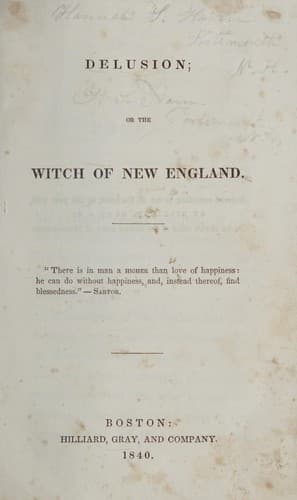
Delusion; or, The Witch of New EnglandLee, Eliza Buckminster
History
Delusion; or, The Witch of New England
Lee, Eliza Buckminster
Paranormal fiction; Salem (Mass.) -- History -- Colonial period, ca. 1600-1775 -- Fiction; Witchcraft -- New England -- Fiction
The neighbors were whispering among themselves, as to what was to be the
fate of the poor child; every one avoiding to look at her, lest it
should imply some design to take charge of her. The child looked on with
wonder, as though she hardly knew why they were there. She had clung to
Dinah as the best known among them; but, when the prayer was finished,
and they began to remove the coffin, she uttered a loud cry, flew from
Dinah's arms, and clung to the bier with all her strength.
The men instinctively paused and laid down their burden. The voice of
nature in that little child was irresistible. They looked at Edith, who
had now made known her promise to the grandmother to take care of the
child, to ask what they should do. She took the child in her arms and
quieted her till all was over, and then, consigning her to the care of
Dinah, she was taken to their own home.
Edith felt deeply the responsibility she had assumed in the care and
instruction of this child. She knew the tenderness of her own heart, her
yielding nature, and feared she should err on the side of too much
indulgence. She said to herself, "She shall never need a mother's care.
I know the heart of the orphan, and no unkindness shall ever make her
feel that she is motherless."
The poor little Phoebe had cried herself to sleep in Dinah's arms, and
had been put to bed in her soiled and dirty state. The next morning a
clean new dress banished the memory of her grandmother, and her childish
tears were dried, and grief forgotten.
Dinah had brought to aid her the power of soap and water, and had
disentangled her really soft and beautiful hair; and when Edith came
down, she would scarcely have known her again. The soil of many weeks
had been taken from the child's skin, and, under it, her complexion was
delicately fair: her cheeks were like pale blush roses, and her lips
were two crimson rosebuds. But with this youthful freshness, which was
indeed only the brilliancy of color, there was an expression in her face
that marred its beauty. It was coarse and earthly, and the absence of
that confiding openness we love to see in children. It reminded one of
her old grandmother; although the one was fair, and smooth, and
blooming, the other dark and wrinkled, a stranger would have said they
were related.
Edith called the child to her, and kissed her fair cheek; but when she
observed the likeness to the old woman, she turned away with a slight
shudder, and something like a sigh.
Dinah, an interested observer of every passing emotion, said, softly,
"The cloud is not gone over yet; a few more tears, and it will pass away
from her young brow, and then it will be fair as your own."
"It is too fair already," answered Edith; "so much beauty will be hard
to guide; and then look at that dark, wayward expression."
"Say not so, my dear mistress;" and Dinah drew back the hair from her
fair forehead. "Look at her beautiful face: in a few days your heart
will yearn to her as mine does to you."
Public-domain text, read in full here on John Shaqi.
Reviews
Reviews
No reviews yet
Be the first to share your thoughts on this work.
Join the Discussion
Join the discussion
Sign in to leave a comment or review.
Sign InorCreate an account