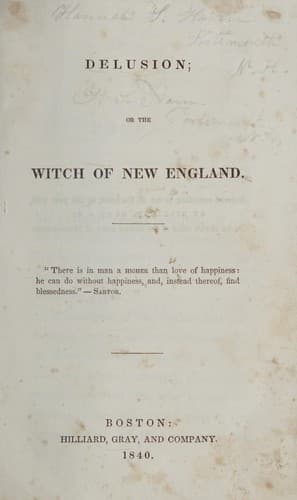
Delusion; or, The Witch of New EnglandLee, Eliza Buckminster
History
Delusion; or, The Witch of New England
Lee, Eliza Buckminster
Paranormal fiction; Salem (Mass.) -- History -- Colonial period, ca. 1600-1775 -- Fiction; Witchcraft -- New England -- Fiction
"God grant I may be as faithful to my duty," said Edith; but this is not
the way to begin it; and she drew the child to her knee, and a few
moments of playful caressing brought smiles to the young countenance
that nearly chased away the dark expression.
Edith, although superior to the age in which she lived, could not but be
influenced by its peculiarities. The belief that an all-pervading and
ever-present Providence directed the most minute, as well as the more
important events of life, was common to the Puritans. She could not free
herself from a superstitious feeling that this child was to have, in
some way or other, she knew not how, an unfavorable influence upon her
happiness. She was free, indeed, from that puerile superstition
"That God's fixed will from nature's wanderings learns."
But the tempest that shook the little building, the incoherent ravings
of the old woman's mind, and the solemn darkness of the hour when she
promised to take charge of the child, had made a deep impression on her
mind.
It is true "that coming events cast their shadows before." Who has not
felt presentiments that certain persons and certain places are, in some
mysterious way, we know not how, connected by invisible links with our
own destiny? The ancients gave to this hidden and mysterious power the
name of Fate. The tragedy of life arises from the powerless efforts of
mortals to contend with its decrees. All that the ancient tragedy taught
was, to bear evils with fortitude, because they were inevitable; but the
"hope that is full of immortality" has taught us that they are the
discipline appointed by Heaven to perfect and prepare our souls for
their immortal destiny.
CHAPTER XIV.
"There has been too much cause to observe that the Christians that
were driven into the American desert which is now called New
England, have, to their sorrow, seen Azahel dwelling and raging
there in very tragical instances."
COTTON MATHER.
The delusion that passed through our country in 1692 has left a dark
chapter in the history of New England. But it was not alone in New
England that this fearful delusion influenced the minds and actions of
men. It was believed all over Europe, in the seventeenth century, that
evil spirits mingled in the concerns of mortals, and that compacts were
made with them, and sealed with the blood of many of the most eminent
persons of the age.
The desire to penetrate the mysteries of the spiritual natures that we
believe every where to surround us, has taken different forms in
different states of society. In New England, it seems to have begun in
the wicked fancies of some nervous or really diseased children, who were
permitted, at last, to accuse and persecute persons who were remarkable
for goodness or intellect, and especially females who were distinguished
for any excellence of mind or person.
Public-domain text, read in full here on John Shaqi.
Reviews
Reviews
No reviews yet
Be the first to share your thoughts on this work.
Join the Discussion
Join the discussion
Sign in to leave a comment or review.
Sign InorCreate an account