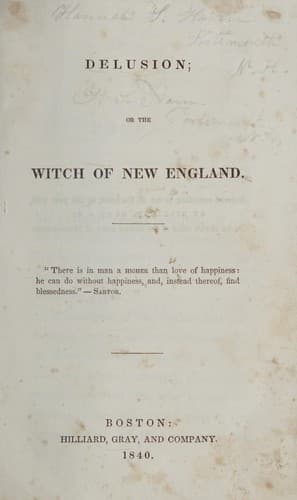
Delusion; or, The Witch of New EnglandLee, Eliza Buckminster
History
Delusion; or, The Witch of New England
Lee, Eliza Buckminster
Paranormal fiction; Salem (Mass.) -- History -- Colonial period, ca. 1600-1775 -- Fiction; Witchcraft -- New England -- Fiction
An historian of the time says, "In the present world, it is no wonder
that the operations of evil angels are more sensible than that of the
good; nevertheless 'tis very certain that the good angels fly about in
our infected atmosphere to minister to the good of those who are to be
the heirs of salvation. Children and ignorant persons first complained
of being tormented and affected in divers manners. They then accused
some persons eminent for their virtues and standing in society."
We have seen that Edith was disposed to think lightly of the subject at
first, although she rejoiced that the old woman of the cliff had escaped
suspicion by a timely death. But when she found that some of her own
neighbors had been suspected, and that one old woman, in another
village, for denying all knowledge of evil spirits, had been executed,
she was filled with consternation; and when others, to save themselves
from the same dreadful fate, increased the delusion of the times by
confessing a compact with the evil one, her pity was mingled with
indignation. With so much clearness of intellect, and simplicity of
heart, she could not persuade herself that it was any thing but wilful
blindness, and a wicked lie.
But Edith began soon to feel much anxiety for her faithful Dinah.
Persons in any way distinguished for any peculiarity were most likely to
be accused, and she had secretly made arrangements to send her away, and
conceal her, should the smallest indication of suspicion fall upon her.
For herself Edith had no fears. It would have been hard to make this
pure and simple-minded creature believe that she had an enemy in the
world. She had not read the French maxim, that there may be such a
weight of obligation that we can only be released from it by
ingratitude.
Dinah had remarked, for several days, in the little Phoebe most strange
and unnatural contortions, and writhings of the body, startings and
tremblings, turning up her eyes and distorting her mouth; and also that
she took little food, and often was absent from home; but, with her
usual tenderness, and fear of giving anxiety to Edith, she had forborne
to mention it.
Indeed, the child had always been wayward and strange, and especially
indocile to Edith's instructions, although she seemed at times to have a
strong affection for her. She was fond of long rambles in the woods, and
of basking in the sun alone on the beach, and retained all her love for
those vagrant habits she had learned from her grandmother. Edith had too
much tenderness and indulgence to restrain what appeared a harmless and
perhaps healthful propensity.
She had tried, however, to civilize the poor, neglected child, and had
taught her to say her prayers every night, kneeling at her side.
Public-domain text, read in full here on John Shaqi.
Reviews
Reviews
No reviews yet
Be the first to share your thoughts on this work.
Join the Discussion
Join the discussion
Sign in to leave a comment or review.
Sign InorCreate an account