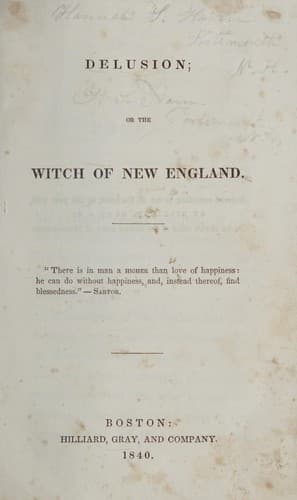
Delusion; or, The Witch of New EnglandLee, Eliza Buckminster
History
Delusion; or, The Witch of New England
Lee, Eliza Buckminster
Paranormal fiction; Salem (Mass.) -- History -- Colonial period, ca. 1600-1775 -- Fiction; Witchcraft -- New England -- Fiction
It was a cold, chilly evening in our tardy spring: the little family had
drawn around the cheerful evening fire, and the evening meal was just
finished: Edith felt happy, for she had been reading a cheerful letter
from Seymore. The shutters were closed, and she had indulged the little
Phoebe, as she often did at this hour, with a noisy game. Edith was
already tired: she looked at the clock: it was the bed hour for the
child.
"Come, my child, be serious for a moment, and say your evening prayer."
Phoebe kneeled: the prayer was short, but whenever she came to the word
God, or Savior, she cried out that she could not say it.
Edith concealed her fears, and said, very quietly, "I will say it for
you; and now, my child, go peaceably to bed, and pray to God to keep you
from telling falsehoods." Phoebe was awed by her calm, decided manner,
and, without further disturbance, went quietly to bed.
Full of anxiety, and even terror, Edith sought her humble friend, told
her the circumstance, and besought her to fly and conceal herself. She
had provided the means for flight and concealment, and entreated her to
use them before it was too late.
"I do not fear for myself, my dear mistress," said Dinah. "If the child
has such design, she has already formed her plan and already accused us;
and she will not be content with accusing me; you are not safe. You do
not know her hard and stubborn temper. She is like the young hawk in the
nest of the dove."
Seeing Edith was dreadfully alarmed, Dinah added, "Do not fear; we are
in _his_ hand who feeds the young ravens, and numbers the hairs of our
heads."
Edith began to be a little more composed, when a loud knocking was
heard at the door. Two men entered, well known to Edith; the officials
in all occasions of this nature. One was the deacon of the church, a
heated fanatic, full of religious bigotry, whose head was too weak to
govern the passionate and blind motions of his heart. While he had been
under the restraint of Mr. Grafton's calm, enlightened reason, he had
been only a zealous and useful officer of the church; but now, that he
considered his own light as no longer hidden under a bushel, his zeal
burned out with more violence, and he lent himself to all the wild
fanaticism of the time. The other was an old man, an elder in the
church; with much tenderness of heart; but he was timid, and relied
little on his own judgment, which was so little enlightened that he
easily yielded to what he afterwards, when the delusion passed away,
bewailed with bitter tears.
Edith was perfectly acquainted with the characters of both. When she saw
them enter, she turned deadly pale; but she pointed courteously to a
seat, and placed herself instinctively between them and Dinah, to shield
her, for she knew too well that there was no escape for her humble
friend if once in their power. She felt, therefore, a sensible relief
when she found that she was herself the object of their visit.
Public-domain text, read in full here on John Shaqi.
Reviews
Reviews
No reviews yet
Be the first to share your thoughts on this work.
Join the Discussion
Join the discussion
Sign in to leave a comment or review.
Sign InorCreate an account