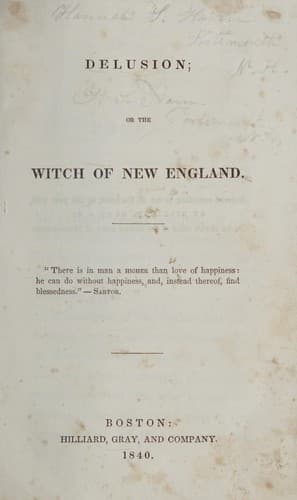
Delusion; or, The Witch of New EnglandLee, Eliza Buckminster
History
Delusion; or, The Witch of New England
Lee, Eliza Buckminster
Paranormal fiction; Salem (Mass.) -- History -- Colonial period, ca. 1600-1775 -- Fiction; Witchcraft -- New England -- Fiction
Edith had had time to recover a little from her first consternation,
and, with much self-possession, she asked who were her accusers, and
demanded the right of being confronted with them.
The men informed her that she would be taken in the morning to the
meeting-house for examination, and then it would be time enough to know
her accusers: in the mean time they should leave a guard in the house,
to prevent all attempts to escape.
Escape! ah, there was none for her. But Edith answered that she wished
not to escape; that she should demand an examination. Alas! she knew not
yet the spirit of the times. She was deluded by her own consciousness of
innocence, and she thought fanaticism itself could not attach a
suspicion to harmlessness like hers.
Not so Dinah. She was seized with a terror and grief that, for one
moment, shook her faith in God, and took away all self-possession. She
knew that innocence, youth, piety, beauty, had been of no avail against
the demoniac fury of the accusers. She besought, on her knees, and with
floods of tears, her dear child--as, in her agitation, she called
her--to avail herself of flight. She convinced Edith that they could
easily elude the vigilance of their guard; that they could escape by
water. Paul was an excellent boatman, the sea smooth as a mirror, the
moon nearly full; they could reach Boston without suspicion. Or she
would hide her in the woods: she herself knew a place where she could
bring her food and clothing, and form a shelter for her, and keep her
safe till all suspicion had ceased.
It would have been better for Edith had she yielded; but her own clear
reason, free from the mists of fanaticism, deluded her into the
persuasion that, as nothing could appear against her, it would confirm
the suspicions against her if she were to avoid by flight a full and
open examination.
Before they retired for the night, they kneeled down to pray. Dinah
could not subdue her sobs; but Edith's voice was calm and firm as she
asked the protection of the Father of the fatherless, and committed her
poor friend to him who is no respector of persons.
Dinah entreated her mistress to allow her to sit by her all night and
watch, while she tried to sleep. This Edith refused: she wished to be
alone. She had much to do to prepare herself for to-morrow, and she
justly feared that Dinah's distress would soften her heart, and shake
her firmness too much.
As they passed through the chamber, Dinah bearing the candle, the little
Phoebe, restless in her sleep, had nearly thrown herself out of bed.
Edith stopped, and, bending over, replaced the bedclothes, and said
softly to Dinah, "If to-morrow should be fatal, if I should not live to
keep my promise to the old woman, I can trust her to you: you will be to
her, as you have been to me, a mother; O, more than a mother?"
Public-domain text, read in full here on John Shaqi.
Reviews
Reviews
No reviews yet
Be the first to share your thoughts on this work.
Join the Discussion
Join the discussion
Sign in to leave a comment or review.
Sign InorCreate an account