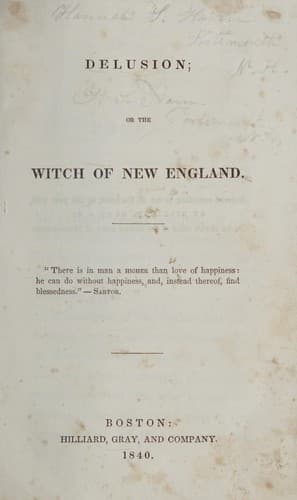
Delusion; or, The Witch of New EnglandLee, Eliza Buckminster
History
Delusion; or, The Witch of New England
Lee, Eliza Buckminster
Paranormal fiction; Salem (Mass.) -- History -- Colonial period, ca. 1600-1775 -- Fiction; Witchcraft -- New England -- Fiction
She stopped; her voice choked. She removed the thick hair from the brow
of the sleeping child, but even in sleep her face wore the frown that so
often marred its beauty. "Dinah," she said, "she is yours; you will love
her as you have me."
"That I can never promise; but I will do my duty," said Dinah.
Edith pressed her lips--thirsting as they ever did for a return of
love--on the fair brow, and then, taking the candle from Dinah, entered
her own room. Her heart was oppressed with apprehension, and she would
not trust herself to say good night to her faithful servants.
CHAPTER XV.
"But ye! ye are changed since ye met me last:
There is something bright from your features past;
There is that come over your heart and eye,
Which speaks of a world where the flowers must die.
Ye smile; but your smile has a dimness yet:
Oh! what have ye looked on since last we met?"
THE VOICE OF SPRING.
Before the events mentioned in the last chapter occurred, the winter had
passed away, and the reluctant footsteps of our northern spring began to
appear. The purple Hepatica opened her soft eye in the woods, and the
delicate Sanguinaria spread her snowy bosom to catch the pale sunbeam.
Already the maple-trees had hung out their beautiful crimson blossoms,
and the thrilling note of the song-sparrow echoed through the forest.
Then came the chilling wind from the east, its wings loaded with frost;
and the timid spring hid her tender blossoms, and wrapped herself in a
watery veil.
The weather and the spring were unnoticed by Dinah, when she sought,
soon after sunrise, the pillow of her mistress. The night had brought
no rest to her throbbing temples and anxious heart: she was surprised,
therefore, to find Edith still sleeping. She had sat up late, arranging
her father's and her own papers, and providing, by a distribution of her
little property, for the old age of her two faithful servants. They were
no longer slaves; Mr. Grafton had given them freedom at his death. She
left the little Phoebe under their guardianship. She had also written a
letter to Seymore, to ask him to come and aid her by his counsel in this
extremity. It was nearly dawn when she sought her pillow; and sleep,
which has been called the friend of sorrow--"but it is the happy who
have called it so"--had only for a few moments left her with untroubled
dreams. Her sleep was not heavy; for the gentle footstep of Dinah awoke
her. When she saw her humble friend's troubled expression, she tried to
smile; and, stroking her dark cheek as she bent over her, she said, "We
must look bright to-day, my poor Dinah, or they will think we are
afraid."
They prepared for the arrival of the officers; and, when breakfast was
ready, the little Phoebe was not to be found. Although Dinah looked
very grave, this occasioned no anxiety in Edith, when she recollected
the vagrant habits of the child.
Public-domain text, read in full here on John Shaqi.
Reviews
Reviews
No reviews yet
Be the first to share your thoughts on this work.
Elsewhere in the archive
Join the Discussion
Join the discussion
Sign in to leave a comment or review.
Sign InorCreate an account