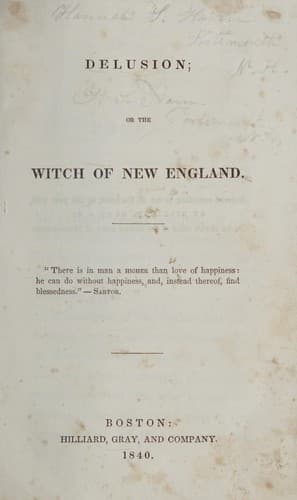
Delusion; or, The Witch of New EnglandLee, Eliza Buckminster
History
Delusion; or, The Witch of New England
Lee, Eliza Buckminster
Paranormal fiction; Salem (Mass.) -- History -- Colonial period, ca. 1600-1775 -- Fiction; Witchcraft -- New England -- Fiction
After breakfast, which was indeed not tasted, the same persons who had
visited her the night before came to conduct Edith to the meeting-house,
the place of examination. The house was nearly full; and among that
crowd there was scarcely one to whom Edith had not been a friend and a
benefactor, as far as her humble means would allow. As she entered,
there was one by whose sick bed she had watched; another whose infant
had died in her arms; and children stood looking on with stupid wonder
to whom she had given flowers, and primers, and, more than all, her own
gentle smile. But now every eye was averted, or turned on her with
suspicion and terror,--so hardening is the power of fanaticism.
I believe I have said that my heroine was not beautiful; but the inward
harmony must have given a spiritual beauty to features animated with
intellect, and softened by tenderness of heart; and a self-relying
innocence and purity imparted something more of grace to her person than
the most finished art could have given.
Edith became very pale as she entered; and Dinah, who had followed her
closely, begged permission to stand near and support her. This was
denied, and she was placed between two men, who each held an arm, and in
front of those who were to examine her.
The afflicted--that is, the accuser--was now called in. Edith looked
eagerly around, and, with grief and astonishment, saw her little Phoebe,
the child of her care, when almost close to her, utter a piercing cry,
and fall down in violent convulsions. She started forward to assist and
raise her, but the men drew her rudely back. And this was her accuser!
At the same time with Edith, a poor old woman, nearly eighty years of
age, was brought in. Her accuser was her own grandchild,--a girl about
the same age as Phoebe. Together they had concerted this diabolical
plot, and had rehearsed and practised beforehand their contortions and
convulsions, excited, no doubt, by the notoriety of wicked children they
had heard of.
The poor old creature was bent and haggard. She would have wept, but,
alas! the fountain of her tears was dried up; and she looked at her
grandchild with a sort of stupid incredulity and wonder. Her inability
to weep was regarded as an infallible proof of her guilt. As she stood
beside Edith, she shook with age and terror; and Edith, touched with
pity, though she trembled herself, and was deadly pale, tried to give
her a smile of hope and encouragement. The poor old wretch did not need
it: she not only confessed to every thing of which she was accused, but
added such circumstances of time and place, and of the various forms the
devil had taken in her person, that Edith almost sickened with disgust.
She could not understand how an old person, on the very verge of the
grave, could wish to lengthen out her few years by such base and wicked
lies.
Public-domain text, read in full here on John Shaqi.
Reviews
Reviews
No reviews yet
Be the first to share your thoughts on this work.
Elsewhere in the archive
Join the Discussion
Join the discussion
Sign in to leave a comment or review.
Sign InorCreate an account