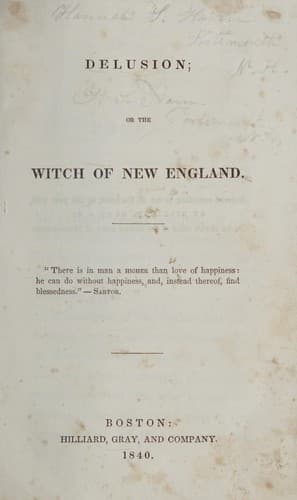
Delusion; or, The Witch of New EnglandLee, Eliza Buckminster
History
Delusion; or, The Witch of New England
Lee, Eliza Buckminster
Paranormal fiction; Salem (Mass.) -- History -- Colonial period, ca. 1600-1775 -- Fiction; Witchcraft -- New England -- Fiction
The young cannot believe that the old are unwilling to die. But it is an
acknowledged truth, that the longer we have worn our earthly vesture,
the dearer becomes the thin and faded remnant. The young resign their
hold of life with hardly a regret, while the old cling with the utmost
tenacity to the wavering and nearly-parted thread.
Edith turned away from the partner of her suspected guilt, and asked to
have the child brought near her. She held out her hand, and looked
mildly in her face. The moment the child touched Edith's hand, she was
still: this was a part of the plot: but the moment her hand was
withdrawn, she fell down again in violent convulsions, and cried out
that pins were thrust into her. In the midst of this acting, she caught
Dinah's stern, reproachful eye fixed upon her, and she instantly became
still. But this did not aid poor Edith's cause; for they cried out that
the child was struck dumb by the accused.
The old woman also, feeling perhaps that Edith's integrity was a
reproach to her own weakness, cried out that she was pierced with pins,
and pinched by Edith, although with invisible fingers, as she stood near
her; and, turning back her sleeve from her bony and wrinkled arm, she
showed a discolored spot, which she declared had not been there when she
left her home. It had not, indeed; but every one knows how quickly a
bruise is visible in the stagnant blood of age, and the mark had been
left by the hand of the person who held her arm.
Edith, wearied and disgusted, desired to be taken back to her prison,
there to await her trial before the judges of the Province. Every thing
had occurred that was most unfavorable to her, and she felt but too well
that she must bear the suspicion of a crime of which she was as
unconscious as the unborn infant. Her heart yearned towards the poor
infatuated child, and she earnestly begged that she might be permitted
to talk with her alone. This was granted, and she was guarded to her
prison.
There was no proper prison in our village, and Edith was guarded in one
of the rooms of the deacon's house who had been so active in her
accusation.
During the night that passed after her examination, Edith had time to
arrange her thoughts. Before she knew who her accusers were, she had
been moving in the dark; and now, when she thought of the whole insane
proceeding, she could scarcely believe they would be guilty of the
monstrous crime of condemning her on the testimony of that child alone.
When the deacon visited her in the morning, she said, with much warmth,
"Have the days of Queen Mary come back? Am I to be suspected, condemned,
imprisoned, on the testimony of that poor child,--the child that I took
to my home when no one else among you would offer her a shelter?"
The deacon answered, "that the testimony was so much more convincing, as
the child had lived in the house with her."
Public-domain text, read in full here on John Shaqi.
Reviews
Reviews
No reviews yet
Be the first to share your thoughts on this work.
Elsewhere in the archive
Join the Discussion
Join the discussion
Sign in to leave a comment or review.
Sign InorCreate an account