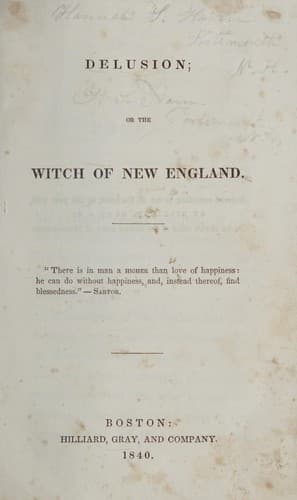
Delusion; or, The Witch of New EnglandLee, Eliza Buckminster
History
Delusion; or, The Witch of New England
Lee, Eliza Buckminster
Paranormal fiction; Salem (Mass.) -- History -- Colonial period, ca. 1600-1775 -- Fiction; Witchcraft -- New England -- Fiction
These trials were held in the meeting-house, and were opened and closed
with a religious service. This seems like a mockery to us, but our
fathers thought they were performing a sacred duty; and however
frivolous or disgusting were many of the details, the trial was rendered
more appalling by giving to the whole the appearance of a holy
sacrifice.
Edith was far from being insensible to the terrors of her situation, but
she found it necessary to assume a cheerfulness she did not feel, in
order to soothe the dreadful agitation of Dinah. The poor African
trusted in God; but she could not shield her child from the tyranny of
human power.
When Edith entered the thronged meeting-house, a paleness, like that of
death, overspread her countenance. She requested that Dinah might stand
near her to support her, lest she should faint. This was rudely denied.
She was answered, "If she had strength to torment that child, she had
strength to stand alone."
She could not wipe the tears that gushed into her eyes at this cruel
answer, for each hand was extended, and closely held by an officer,--a
precaution always adopted in these trials, lest the prisoner should
afflict some person in the crowded multitude.
She had no sooner become a little calm, than her eye sought Seymore
among the crowd. She was shocked with the change an "o'erwrought spirit"
had effected in his person. His pale forehead was traced with veins that
were swelled almost to bursting; a fire was burning in his dark, sunken
eyes, and crimson spots flushed each cheek.
As Edith looked at him, her heart swelled with an infinite pity. For the
moment, her own appalling situation melted away from her thoughts. For
the moment, it was of little importance to her whether she lived or
died. All she wished was to be near Seymore, to speak to him, to soothe
and calm his agitated spirit.
She was recalled to herself by the opening of the trial. The prisoner
was first commanded to repeat the Lord's prayer. This Edith did in a
low, sweet voice, that sounded to the hushed audience like plaintive
music.
It is not my purpose to enter into the details of this trial. It is
enough that "every idle rumor, every thing that the gossip of the
credulous, or the fertile memories of the malignant could produce that
had an unfavorable bearing on the prisoner, however foreign it might be
to the indictment, was brought before the jury,"[3] in addition to the
testimony of the child, and the falsehood of the old woman.
[Footnote 3: Upham's History of Witchcraft.]
The cause was at length given to the jury. They did not leave their
seats; and when it came to the turn of Seymore, who was the last to
speak, the crimson blood rushed to the cheek, brow, and temples of
Edith, and then left them paler than before: a sick sensation came over
her, and she would have fainted, had she not been relieved by tears,
burning hot, that gushed from her eyes.
Public-domain text, read in full here on John Shaqi.
Reviews
Reviews
No reviews yet
Be the first to share your thoughts on this work.
Elsewhere in the archive
Join the Discussion
Join the discussion
Sign in to leave a comment or review.
Sign InorCreate an account