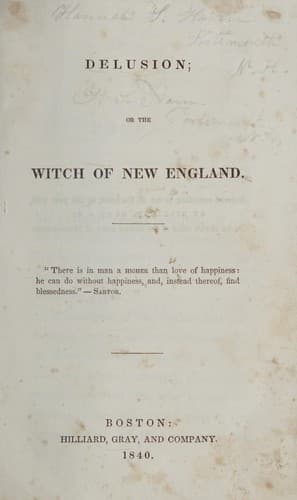
Delusion; or, The Witch of New EnglandLee, Eliza Buckminster
History
Delusion; or, The Witch of New England
Lee, Eliza Buckminster
Paranormal fiction; Salem (Mass.) -- History -- Colonial period, ca. 1600-1775 -- Fiction; Witchcraft -- New England -- Fiction
Seymore had covered his face when he first entered, and had not looked
at Edith. So hushed was the crowd, that the word "_guilty_," wrung as it
were from him in the lowest whisper, was heard distinctly through the
whole meeting-house. It pierced Edith's ear like the voice of a trumpet;
and from that moment the spirit of a martyr entered her breast. She felt
herself deserted by the whole of her little world, falsely convicted of
a crime she abhorred, and left without human sympathy. She turned to
God. "He who seeth in secret," she said, "knows my innocence;" and she
bowed her head, and made no further answer.
The trial was closed as it began,--with religious services. A hymn was
sung; and Edith, feeling, as I have said, an elevation that she could
not herself understand, joined in the devotion. The others stopped; for
they would not mingle their voices with one convicted of witchcraft: the
very evil one was mocking them. Edith continued alone; and her rich,
sweet tones thrilled their hearts like the voice of an angel. She was
reminded by a whisper from Dinah that she was singing alone; and,
ceasing, she blushed deeply, and covered her face from the curious gaze
of the multitude.
As Edith returned to her prison, guarded on each side, and followed by
Dinah, she thought of the Lady Ursula, whose cruel fate had moved her so
deeply. And was she indeed the same person? The child that had wept her
fate so bitterly was now to meet one far more terrible: and she felt
strength to meet it. Every wave, as it had passed over her, had brought
out the hidden beauty and strength of her soul; and, though there was in
her no air of triumph, a tranquil contentment and repose was expressed
in her whole person.
CHAPTER XVIII.
"No, never more, O, never in the worth
Of its pure cause, let sorrowing love on earth
Trust fondly,--never more! The hope is crushed
That lit my life,--the voice within me hushed
That spoke sweet oracles."
The unnatural excitement that had borne our heroine up during the last
part of her trial forsook her when she entered once more her dreary
prison. She was again alone,--again a weak and timid woman. The
momentary exaltation that a sense of injustice had given her when under
the gaze of numbers, gave way to memories of the deep and unforgotten
happiness she had connected with Seymore. All her sweet anticipations of
soothing his spirit, of leading him to more rational views of God and of
himself, faded away. In a few days, she would be no more, and
remembered, perhaps, with pity or scorn. One last, lingering weakness
remained: it was the fear of losing the respect and tenderness of
Seymore.
Public-domain text, read in full here on John Shaqi.
Reviews
Reviews
No reviews yet
Be the first to share your thoughts on this work.
Elsewhere in the archive
Join the Discussion
Join the discussion
Sign in to leave a comment or review.
Sign InorCreate an account