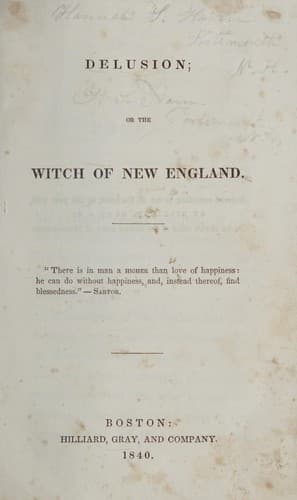
Delusion; or, The Witch of New EnglandLee, Eliza Buckminster
History
Delusion; or, The Witch of New England
Lee, Eliza Buckminster
Paranormal fiction; Salem (Mass.) -- History -- Colonial period, ca. 1600-1775 -- Fiction; Witchcraft -- New England -- Fiction
Edith's hand trembled in his, but she answered cheerfully: "The close!
ah, no: look upward. God has tried us both with grievous trials. Mine
will cease first. Yours is the hardest to bear: to linger here--to do
God's work alone. Let me be to you like one departed a little while
before you, that would not be mourned, but remembered always."
They were both silent for some moments; Seymore contending with
unutterable regret, oppressed with an emotion that was almost the agony
of remorse.
Edith understood his contending emotions. "Think," she said, "that you
have been the instrument of Providence to lead me to heaven. I do not
regret to die early: God has permitted me to solve the mystery of life.
I see his hand even from the moment when that child was committed to my
care. Thank God, I can now submit to his will; and, although life were
sweet with you, my death may bring you nearer to heaven."
"Edith," he said at last, "I have been deceived. Such faith, such divine
forgiveness, such noble fortitude, cannot be the work of evil spirits.
Your faith is purer and stronger than mine,--your reason more
enlightened. I have erred, dreadfully erred."
A bright smile illumined her face, and she pressed his hand in hers.
"I have done most dreadfully wrong," he said; "I sinned from ignorance."
"God will forgive you," said Edith; "and I,--I cannot forgive, for I
could not blame."
He started up. "It is not too late to repair this dreadful evil: it will
be easy for you to escape. If I cannot gain a reversion of the
sentence, we can escape: we will leave this country of delusion and
error; we will go home--to England. There, O Edith--"
The blood for a moment rushed to Edith's cheek and brow; but she
answered, sadly, "No, Seymore, it cannot be; after all that has passed,
it would ruin your character, your prospects, your usefulness, forever.
We are too weak to stem, to oppose this mad delusion. Bigotry and power
are all around us."
"You hesitate. Ah, you do not love me as you did;" and he became again
violently agitated.
Edith took his hand in hers, and pressed it to her lips. "Tempt me not,"
she said, "with visions of happiness that can never be. Let us rather
pray to God to support us in this bitter hour."
They bowed their young heads together, and their tears mingled. Edith's
silent prayer was wholly for him. True to her woman's nature, she forgot
herself in his deeper sorrow.
He was calm, and Edith would not prolong the interview; and Seymore left
her all the more hastily as he was determined to employ every means to
save her. He was not permitted to enjoy that happiness.
CHAPTER XIX.
"See, they are gone!--
The earth has bubbles, as the waters have,
And these are some of them. They vanished
Into the air, and what seemed corporal,
Melted as breath into the wind."
SHAKSPEARE.
Public-domain text, read in full here on John Shaqi.
Reviews
Reviews
No reviews yet
Be the first to share your thoughts on this work.
Elsewhere in the archive
Join the Discussion
Join the discussion
Sign in to leave a comment or review.
Sign InorCreate an account