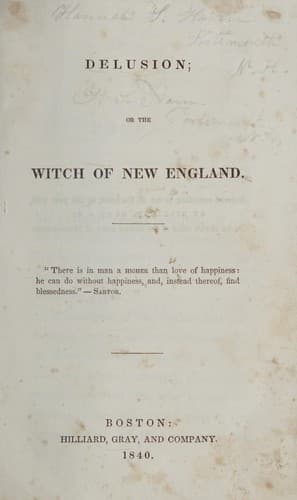
Delusion; or, The Witch of New EnglandLee, Eliza Buckminster
History
Delusion; or, The Witch of New England
Lee, Eliza Buckminster
Paranormal fiction; Salem (Mass.) -- History -- Colonial period, ca. 1600-1775 -- Fiction; Witchcraft -- New England -- Fiction
[Footnote 4: "Fifty-five persons, many of them previously of the most
_unquestionable character for intelligence, virtue, and piety_,
acknowledged the truth of the charges that were made against them,
confessed that they were witches, and had made a compact with the devil.
It is probable that the motive of self-preservation influenced most of
them: an awful death was in immediate prospect. The delusion had
obtained full possession of the people, the witnesses, the jury, and the
court. By acknowledging the crime, they might in a moment secure their
lives and liberty. Their principles could not withstand the temptation:
they made a confession, and were rewarded by a pardon."--_Upham's
Lectures on Salem Witchcraft._]
"But _I_ should confess to a lie,--a base and wicked lie. I have no
faith in these temptations. I believe God suffers us to be tempted by
our own passions and unrestrained imaginations, but not by visible or
invisible evil spirits. O, listen to me: go no further in this mad,
this wicked delusion. Spare the innocent blood that will be shed. If I
must die, let my death be the means of turning you and others from this
dreadful sin."
"And can you bear to have your name sullied by this alliance with the
wicked? Those who die as criminals are believed guilty of crimes; and
can you consent to be remembered as the associate of evil spirits?"
"Falsehood can live but a few years," she answered; "there is an
immortality in truth and virtue. I cannot blush to be confounded with
the guilty; for it is my unwillingness to sully my conscience with a lie
that leads me there."
Seymore was silent for a few moments. "Edith," he said at last,
straining both her hands in his, "have you been able to think how cruel
this death may be? Have you fortitude? Can you bear to think of it?" and
he shuddered, and covered his face with his hands.
Edith for a moment turned pale. "I have ever shrunk," she said, "from
physical pain. My own extreme timidity has never given me courage to
bear the least of its evils. I believe, then, that it will be spared me:
God will give me courage at the moment, or he will mercifully shorten
the pain; for what is beyond our strength we are not called to bear."
"And can you part with life thus triumphantly?"
"Ah, my friend, there is no triumph in my soul. In its deepest
sanctuary, I feel that God will pardon my sins, and accept my death as
in obedience to my conscience. But, O! I have not sought it: life is
still sweet to me."
"You shall not die,--you must not! you will not leave me! Edith, have
you forgotten our moments of bliss,--our dreams of happiness to
come,--the quiet home, the peaceful fireside, where we hoped to pass our
lives together? Have you forgotten how long, how truly, how fervently, I
have loved you? and is this to be the close of all?"
Public-domain text, read in full here on John Shaqi.
Reviews
Reviews
No reviews yet
Be the first to share your thoughts on this work.
Elsewhere in the archive
Join the Discussion
Join the discussion
Sign in to leave a comment or review.
Sign InorCreate an account