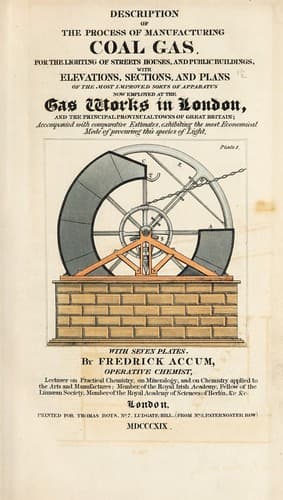
Description of the Process of Manufacturing Coal Gas, for the Lighting of Streets Houses, and Public Buildings: With Elevations, Sections, and Plans of the Most Improved Sorts of Apparatus Now Employed at the Gas Works in London and the Principal Provincial Towns of Great Britain; Accompanied With Comparative Estimates, Exhibiting the Most Economical Mode of Procuring This Species of LightAccum, Friedrich Christian
History
Description of the Process of Manufacturing Coal Gas, for the Lighting of Streets Houses, and Public Buildings: With Elevations, Sections, and Plans of the Most Improved Sorts of Apparatus Now Employed at the Gas Works in London and the Principal Provincial Towns of Great Britain; Accompanied With Comparative Estimates, Exhibiting the Most Economical Mode of Procuring This Species of Light
Accum, Friedrich Christian
Gas manufacture and works -- Great Britain; Gas-lighting
The size, form and intensity of the gas flame, are regulated by simply
turning the stop-cock which admits the gas to the burner or lamp. The
flame may at command be made to burn with an intensity sufficient to
illuminate every corner of a room, or so low and dim, as barely to be
perceived. It is unnecessary to point out how valuable lights of this
description are in nurseries, stables, warehouses, and chambers of the
sick. From the facility with which the gas flame can be conveyed in
almost any direction, from the diversified size and shape which it can
be made to assume, there is no kind of light so well adapted for
ornamental illumination.
The flame of coal gas is of a pure white colour, and of a body full and
compact. In large masses, it becomes of the same flickering character
which is common to all flames of large dimensions, and is owing to the
agitation of the surrounding heated atmosphere.
The saving of labour connected with the employment of gas-light, may
seem on a small scale to be trifling; but when it is considered that in
large manufactories, it is not unusual to find several persons employed
for no other purpose than trimming the lamps or setting and snuffing the
candles of the establishment, the advantage gained on this head by the
use of a species of light which require no sort of attention whatever,
cannot but appear very considerable.
The cleanliness of the gas-lights is also a consideration of no small
importance, they are attended with none of that spilling of oil, and
dropping of grease, which makes the employment of oil-lamps and candles
so injurious in many warehouses, shops and private dwellings.
The flame of a gas-light compared in point of brilliancy to that of a
candle, is as the flame of a common oil lamp, compared to the flame of a
lamp of Argand. The difference between a street, on the night of a
general illumination, and any other night when the street is under the
dull glimmering light of the ordinary oil lamps, is scarcely more
remarkable, than the difference between a street lighted by gas, and one
lighted by oil. While the ordinary oil lamps may be said merely to serve
the purpose of making “_darkness visible_,” the gas-lights really dispel
the dominion of night, and diffuse a body of light so wide-spreading and
intense, as almost to rival the clearest moonshine.
Public-domain text, read in full here on John Shaqi.
Reviews
Reviews
No reviews yet
Be the first to share your thoughts on this work.
Join the Discussion
Join the discussion
Sign in to leave a comment or review.
Sign InorCreate an account