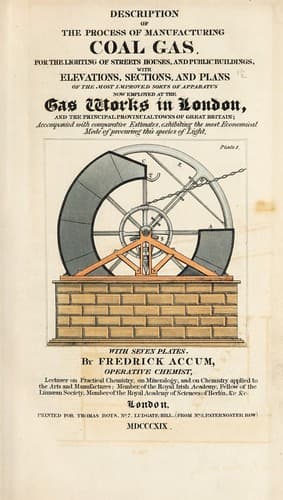
Description of the Process of Manufacturing Coal Gas, for the Lighting of Streets Houses, and Public Buildings: With Elevations, Sections, and Plans of the Most Improved Sorts of Apparatus Now Employed at the Gas Works in London and the Principal Provincial Towns of Great Britain; Accompanied With Comparative Estimates, Exhibiting the Most Economical Mode of Procuring This Species of Light — John Shaqi
Description of the Process of Manufacturing Coal Gas, for the Lighting of Streets Houses, and Public Buildings: With Elevations, Sections, and Plans of the Most Improved Sorts of Apparatus Now Employed at the Gas Works in London and the Principal Provincial Towns of Great Britain; Accompanied With Comparative Estimates, Exhibiting the Most Economical Mode of Procuring This Species of LightAccum, Friedrich Christian
History
Description of the Process of Manufacturing Coal Gas, for the Lighting of Streets Houses, and Public Buildings: With Elevations, Sections, and Plans of the Most Improved Sorts of Apparatus Now Employed at the Gas Works in London and the Principal Provincial Towns of Great Britain; Accompanied With Comparative Estimates, Exhibiting the Most Economical Mode of Procuring This Species of Light
Accum, Friedrich Christian
Gas manufacture and works -- Great Britain; Gas-lighting
The fifth and sixth parts, lead the reader considerably further into a
knowledge of the economy and practice of this art. They contain an
account of a great variety of experiments which have been pursued on a
large scale, in order to ascertain the most profitable mode of
employing the retorts, the differences of opinion which have existed
among practical men with respect to the degree of temperature fittest to
be applied, and the number of hours at a time during which the retorts
may most advantageously be kept in action, with the particular results
which the experiments instituted into these points have afforded; and
such other data, as will enable the reader to adopt that mode of
operation, which under every circumstance of locality will be found most
advantageous.
The changes which have taken place with respect to the retorts, have
been before detailed in part fourth; but in order to give the
manufacturer a nearer insight into the superior advantages attending
retorts of the construction lately brought into use, I have given in
part seventh, a detailed description of the horizontal rotary retorts,
the application of which has led to a more economical, expeditious, and
easy method of manufacturing coal gas than heretofore practised. I have
distinctly pointed out the advantages which these retorts present, the
particular results they afford, and the method of applying them.
The purification of coal gas forms the subject of part eighth. I have
compared here, the apparatus for purifying coal gas, as it was
originally constructed, with the improved machinery lately adopted,
showing the inefficacy and defects of the former, and the decided
superiority which belongs to the latter.
The ninth part gives an account of the various improved gas holders
which have been invented, and now are in action at the most recent
establishments, for the purpose of storing large quantities of gas. The
improvements that have been made in this department of the Gas Light
machinery, are particularly valuable and have contributed more perhaps
than any other, to lessen the expence of manufacturing gas for
commercial purposes.
In the tenth part, I have given a description of an entirely new
machine, called the gas-metre, or self-acting guage, lately adopted at
the Birmingham, Chester, and other gas works, which measures and
registers the quantity of gas manufactured in any given time, from any
given quantity of coal, or consumed during any period, by any number of
burners or lamps. The great services which such a machine must render
both to the manufacturer and consumer of gas, are particularly pointed
out, and illustrated to the manufacturer, by serving as a complete check
on his workmen as to the quantity of work that ought to be performed,
and to the consumer, as an exact measure of the quantity of gas he
receives, and ought to pay for.
Reviews
Reviews
No reviews yet
Be the first to share your thoughts on this work.
Join the Discussion
Join the discussion
Sign in to leave a comment or review.
Sign InorCreate an account