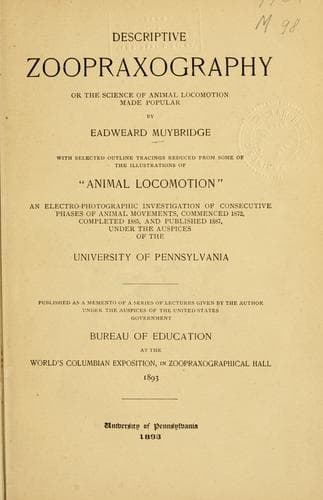
Descriptive Zoopraxography; or, the science of animal locomotion made popular — John Shaqi
Descriptive Zoopraxography; or, the science of animal locomotion made popularMuybridge, Eadweard
Science
Descriptive Zoopraxography; or, the science of animal locomotion made popular
Muybridge, Eadweard
Animal locomotion
Selecting for the purpose of illustration the phases occurring during two
steps or one-half of a stride of 18 feet in length by a horse trotting at
the rate of a mile in two minutes and twelve seconds, we find that at the
instant his right fore foot strikes the ground, the left hind foot is a few
inches behind the point where it will presently strike. As the feet
approach the ground, the right hind leg is drawn forward with the pastern
nearly horizontal, while the left fore leg is flexed under the body. After
the feet strike the ground and the legs approach a vertical position the
pasterns are gradually lowered, and act as springs to break the force of
the concussion until they are sometimes bent to a right angle with the
legs.
At this period the fore foot is raised so high as to frequently strike the
elbow, while the diagonal hind foot is comparatively but little above the
ground, and is about to pass to the front of the left hind.
The pasterns gradually rise as the legs pass the vertical until the right
fore foot has left the ground and the last propelling force is being
exercised by the left hind foot; which accomplished, the animal is in mid
air.
The right hind foot continues its onward motion until it is sometimes much
in advance of its lateral fore foot, the former, however, being gradually
lowered, while the latter is being raised. The right hind and both fore
legs are now much flexed, while the left hind is stretched backwards to its
greatest extent with the bottom of the foot turned upwards, the left fore
leg is being thrust forwards and gradually straightened, with the toe
raised as the foot approaches the ground; which accomplished, with a
substitution of the left limbs for the right, we find them in the same
relative positions as when we commenced our examination, and one-half of
the stride is completed.
[Illustration: SOME CONSECUTIVE PHASES OF THE TROT.]
With slight and immaterial differences, such as might be caused by
irregularities of the ground, these movements are repeated by the other
pair of diagonals, and the stride is then complete.
If the stride of a trotting horse is divided into two portions,
representing the comparative distances traversed by the aggregate of the
body while the feet are in contact with, and while they are entirely clear
of, the ground, the relative measurements will be found to vary very
greatly, they being contingent upon length of limb, weight, speed, and
other circumstances.
Heavily built horses will sometimes merely drag the feet just above the
surface, but, in every instance of a trot, the _weight_ of the body is
really unsupported twice during each stride. It sometimes happens that a
fast trotter, during the four steps of a stride, will have all his feet
clear of the ground for a distance exceeding one-half of the length of the
entire stride. Upon landing, a fore foot almost always precedes its
diagonal hind.
Public-domain text, read in full here on John Shaqi.
Reviews
Reviews
No reviews yet
Be the first to share your thoughts on this work.
Join the Discussion
Join the discussion
Sign in to leave a comment or review.
Sign InorCreate an account