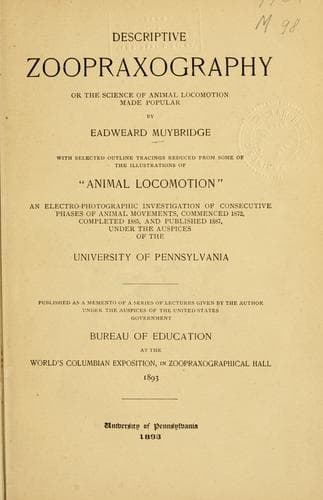
Descriptive Zoopraxography; or, the science of animal locomotion made popularMuybridge, Eadweard
Science
Descriptive Zoopraxography; or, the science of animal locomotion made popular
Muybridge, Eadweard
Animal locomotion
containing more than 20,000 figures of men, women, and children, animals
and birds, actively engaged in walking, galloping, flying, working,
jumping, fighting, dancing, playing at base-ball, cricket, and other
athletic games, or other actions incidental to every-day life, which
illustrate motion or the play of muscles.
These sheets of illustrations are conventionally called "plates."
EACH PLATE IS COMPLETE IN ITSELF WITHOUT REFERENCE TO ANY OTHER PLATE,
and illustrates the successive phases of a single action, photographed with
automatic electro-photographic apparatus at regulated and accurately
recorded intervals of time, _consecutively_ from one point of view; or,
_consecutively_ AND _synchronously_ from _two_, or from _three_ points of
view.
A series of twelve consecutive exposures, from each of the three points of
view, are represented by an outline tracing on a small scale of plate 579,
a complete stride of a horse walking; the intervals of exposures are
recorded as being one hundred and twenty-six one-thousandths of a second.
[Illustration: REDUCED OUTLINE TRACING OF PLATE 579.--"ANIMAL LOCOMOTION."]
[Illustration: REDUCED TRACING OF SOME PHASES FROM PLATE 758.]
[Illustration: REDUCED TRACINGS OF PLATE 347.]
When one of the series of foreshortenings is made at a right angle with the
lateral series the arrangement of the phases is usually thus:
1 2 3 4 5 6 7 8 9 10 11 12 Laterals.
1 2 3 4 5 6 7 8 9 10 11 12 Rear Foreshortenings
from points of view on
the same vertical line,
at an angle of 90 deg.
from the Laterals.
1 2 3 4 5 6 7 8 9 10 11 12 Front Foreshortenings
from points of view on
the same horizontal
plane, at suitable angles
from the Laterals.
The plates are not _photographs_ in the common acceptation of the word, but
are printed in PERMANENT INK, from gelatinised copper-plates, by the New
York Photo-Gravure Company, on thick linen plate-paper.
The size of the paper is 45 × 60 centimetres--(19 × 24 inches), and the
printed surface varies from 15 × 45 to 20 × 30 centimetres--(6 × 18 to 9 ×
12 inches).
The number of figures on each plate varies from 12 to 36.
To publish so great a number of plates as one undivided work was considered
unnecessary, for each subject tells its own story; and inexpedient, for it
would defeat the object which the University had in view, and limit its
acquisition to wealthy individuals, large Libraries, or Institutions where
it would be beyond the reach of many who might desire to study it.
Public-domain text, read in full here on John Shaqi.
Reviews
Reviews
No reviews yet
Be the first to share your thoughts on this work.
Join the Discussion
Join the discussion
Sign in to leave a comment or review.
Sign InorCreate an account