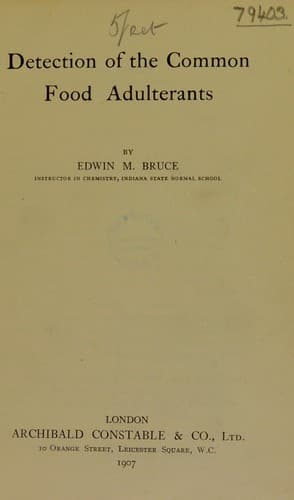
Detection of the Common Food AdulterantsBruce, Edwin M.
Science
Detection of the Common Food Adulterants
Bruce, Edwin M.
Food adulteration and inspection
The ash of genuine honey is not over 0.3 per cent. Whenever the ash is
greater than this it should be tested for calcium sulfate, the presence
of a considerable quantity of which is an almost certain proof that
starch glucose or invert sugar has been added to the honey. Sulfates may
be detected by adding barium chlorid to the aqueous solution of the
honey and precipitating barium sulfate.
If the ash is high and considerable chlorids are present, molasses has
quite probably been added to the honey. The presence of chlorids may be
determined by the addition of silver nitrate which precipitates silver
chlorid.
CANE SUGAR
The presence of cane sugar can be detected with certainty only by the
use of the polarimeter. Its presence in large quantity gives a high
right-handed rotation.
COMMERCIAL GLUCOSE SYRUP
_Allen’s Test._--Make the test for dextrine which is present in
commercial glucose, but not in pure honey. Dilute a portion of the honey
with an equal volume of water and add methyl alcohol with constant
stirring until there is a permanent turbidity. If glucose syrup is
present a heavy gummy precipitate will soon form. Genuine honey gives
only a slight milkiness.
GELATIN
Dilute a portion of the sample and add a solution of tannic acid. A
precipitate indicates the presence of gelatin.
Treat the sample with alcohol, and gelatin, if present, will be left
undissolved, and it will give its characteristic odor on ignition.
MAPLE SYRUP
This is sometimes adulterated with glucose, molasses, golden syrup, and
with ordinary white sugar. There are no satisfactory simple chemical
tests for these substances.
Pure maple syrup should have an ash not lower than 0.35 to 0.40 per
cent. A lower ash shows that cane sugar has been added. A higher ash
would indicate the presence of molasses or brown sugar stock. These last
two adulterants, if present in great abundance, may be detected by
taste.
GLUCOSE
This may be detected by the use of the polarimeter. Pure maple syrup
gives 53.1 to 60 direct, and--22.2 to--21.9 after hydrolysis. Maple
syrup adulterated with glucose gives 80 to 100 direct and 18.9 to 45.6
after hydrolysis (according to Ogdon).
CHAPTER IX
SPICES
MUSTARD
Mustard is often adulterated with mustard hulls, wheat, and rice. And
when white-colored flour of any kind is used, turmeric, Martius yellow,
or a coal-tar color is employed to give the mixture the color of
mustard. Cayenne pepper is occasionally used to impart pungency to
diluted mustard.
FLOUR
Boil 2 grams of the mustard in 4 or 5 cc. of distilled water for about
10 minutes. After it is cool, add a few drops of iodin solution slowly,
avoiding a large excess though having a little uncombined iodin. If a
blue color is produced, some starchy matter has been added to the
mustard. The intensity of the reaction is an indication of the amount of
starchy matter used. Pure mustard contains no starch and hence gives no
reaction with iodin.
COLORING MATTER
Public-domain text, read in full here on John Shaqi.
Reviews
Reviews
No reviews yet
Be the first to share your thoughts on this work.
Join the Discussion
Join the discussion
Sign in to leave a comment or review.
Sign InorCreate an account