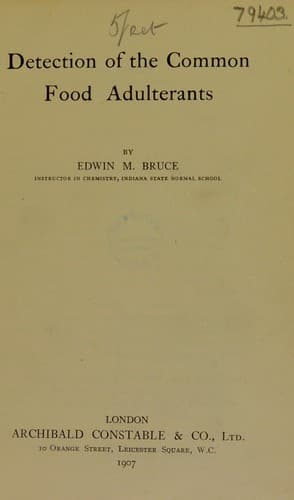
Detection of the Common Food AdulterantsBruce, Edwin M.
Science
Detection of the Common Food Adulterants
Bruce, Edwin M.
Food adulteration and inspection
_Jumeau’s Test._--Dissolve 5 grams of iodin in a mixture of 50 cc. of
ether and 50 cc. of alcohol. Cover the bottom of a porcelain capsule
with the finely ground pepper, and add just enough of the iodin mixture
to wet the entire mass, and mix well till it has the same consistency
throughout. Let dry in the air, then powder and examine it, and if olive
stones are present they will be colored yellow. Pure pepper would have a
deep brown color.
Aniline acetate, one part aniline in 3 parts acetic acid, colors pure
pepper gray or white and olive stones yellowish brown.
CAYENNE
Heat some of the red particles found in the pepper and their
characteristic vapor is produced. Dissolve the particles in alcohol or
ether and the same vapors are produced.
CHAPTER X
VINEGAR
Vinegars may be adulterated by the addition of mineral acids as sulfuric
or hydrochloric. Caramel or the coal-tar dyes may be employed to improve
the color or to give color to an artificial product. Malic acid is
always present in cider vinegar. Potassium acid tartrate occurs in true
wine vinegar. Poisonous metals may be present in vinegars containing
free mineral acid. Entirely artificial cider vinegar is often found on
the market.
PREPARATION OF THE SAMPLE FOR TESTING
If the vinegar is turbid from any suspended matter, it should be
filtered. The samples should be analyzed at once, and in the laboratory
they should always be kept in glass-stoppered bottles.
_General Observations._--Ignite a little of the vinegar residue on a
clean platinum wire in a colorless Bunsen flame, and if it is pure cider
vinegar the flame will be colored the characteristic lilac color of
potassium. The sodium flame is absent or only a mere trace of it is
present. But in all artificially colored vinegars, spirit sugar and
glucose vinegars, the sodium flame predominates.
The residue of cider vinegar is thick, viscid, or mucilaginous, of a
light brown color, astringent acid taste though not unpleasant. The
solids of sugar-house vinegar, those from colored spirit and wood
vinegar, each have a bitter taste on account of the caramel used to
color them. The residue of the sugar-house vinegar has the odor of
molasses. Wood vinegar when present gives a residue with a tarry or
smoky taste and smell. Glucose vinegar gives the odor of scorched corn.
Solids of fruit vinegars are quite soluble in alcohol, except a granular
residue in grape vinegar, while the solids of malt and glucose vinegars
are almost insoluble.
The ash of fruit vinegars and malt vinegars has a distinct alkaline
reaction, while that of spirit and wood vinegars is very feebly
alkaline.
FREE MINERAL ACIDS
The ash of pure cider vinegar is always alkaline. If a vinegar should
show a neutral reaction this would certainly indicate the presence of a
free mineral acid. If the ash be alkaline, no acid except nitric could
have been present, and this is seldom, if ever, used as an adulterant of
vinegar.
WHEN THE ASH IS ALKALINE APPLY
Public-domain text, read in full here on John Shaqi.
Reviews
Reviews
No reviews yet
Be the first to share your thoughts on this work.
Join the Discussion
Join the discussion
Sign in to leave a comment or review.
Sign InorCreate an account