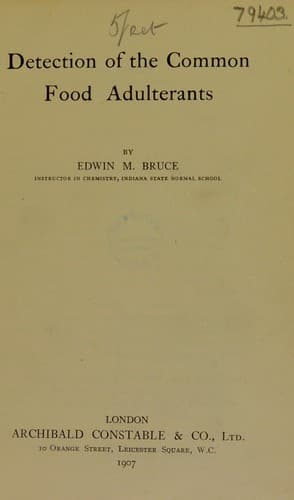
Detection of the Common Food AdulterantsBruce, Edwin M.
Science
Detection of the Common Food Adulterants
Bruce, Edwin M.
Food adulteration and inspection
_Allen’s Method._--Boil the coffee in 10 parts of water. When perfectly
cold add to it a little sulfuric acid, then a strong solution of
potassium permanganate, drop by drop, with constant shaking, till the
liquid is almost decolorized; strain or decant and add to the solution a
solution of iodin. If 1 per cent or more of starch is present, a blue
coloration will be produced.
CHICORY
_Rimmington’s Test._--Boil a portion of the sample with water which
contains a little sodium carbonate; decant, wash and treat the residue
with a weak solution of bleaching powder for several hours. The solution
will be decolorized. The coffee will be at the bottom as a dark layer
while the chicory will be a light layer above it.
_Albert Smith’s Test._--Boil 10 grams of the sample in 250 cc. of water;
strain and add basic lead acetate in slight excess. A precipitate forms,
and when it has settled the supernatant liquid will be colorless if the
coffee is pure, but more or less colored if chicory is present.
TEA
Tea is adulterated by the substitution of inferior grades for those of
better quality, by the addition of exhausted leaves and foreign leaves,
by the use of coloring matter or “facing” such as Prussian blue, indigo,
or turmeric to color green tea, and sometimes graphite to color black
tea. Foreign astringents (generally catechu) are added to conceal the
presence of exhausted leaves. An imitation tea, “lie tea,” is made of
the stems and dust with mineral matter, and some starch or gum to hold
these together.
FOREIGN LEAVES
Though there are several chemical tests for foreign leaves, none are as
satisfactory as a microscopical examination. Soften the leaves by
soaking in hot water, unroll carefully and examine with a hand lens or
low power of the microscope. Compare with a genuine leaf--the shape,
margin, and venation.
EXHAUSTED TEA LEAVES
Sometimes such leaves may be detected by a physical examination. They
are often more or less unrolled and broken on the edges. But the only
certain way of ascertaining their presence is to determine the soluble
ash which is from 2.5 to 4 per cent in pure tea and usually less than
0.8 per cent in exhausted tea.
LIE TEA
This imitation tea is easily detected by pouring hot water over the
leaves. If they are artificial, they will break down into the fragments
of which they were made.
FACING
Organic coloring matter may be detected by the same method used for
detecting such colors in coffee.
CATECHU
_Hager’s Test._--Boil a little of the tea in water, and add to the
extract an excess of lead monoxid. If the tea is pure the addition of a
solution of silver nitrate produces only a slight grayish precipitate,
but when catechu is present a yellow flocculent precipitate forms.
A FEW OF THE BEST BOOKS ON FOOD ANALYSIS
ALLEN, A. H., Commercial Organic Analysis, 1898. Price, $29.50.
BLYTH, A. W., Foods, their Composition and Analysis, 1903. Price,
$8.40.
Public-domain text, read in full here on John Shaqi.
Reviews
Reviews
No reviews yet
Be the first to share your thoughts on this work.
Join the Discussion
Join the discussion
Sign in to leave a comment or review.
Sign InorCreate an account