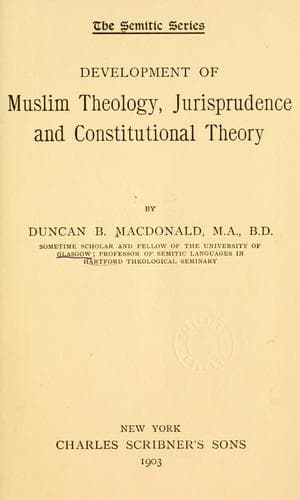
Development of Muslim Theology, Jurisprudence, and Constitutional TheoryMacDonald, Duncan Black
ReligionIslamic
Development of Muslim Theology, Jurisprudence, and Constitutional Theory
MacDonald, Duncan Black
Constitutional law (Islamic law); Islam -- Doctrines -- History; Islam and state -- History; Islamic law -- History
But most unfortunately for the Mu‘tazilites and for Islam, a Khalifa
arose who had a relish for theological discussions and a high opinion
of his own infallibility. This was al-Ma’mun. It did not matter that
he ranged himself on the progressive side; his fatal error was that he
invoked the authority of the state in matters of the intellectual and
religious life. Thus, by enabling the conservative party to pose as
martyrs, he brought the prejudices and passions of the populace still
more against the new movement. He was that most dangerous of all beings,
a doctrinaire despot. He had ideas and tried to make other people live up
to them. Al-Mansur, though a bloody tyrant, had been a great statesman
and had known how to bend people and things quietly to his will. He had
sketched the firm outlines of a policy for the Abbasids, but had been
cautious how he proclaimed his programme to the world. The world would
come to him in time, and he could afford to wait and work in the dark.
He knew, above all, that no people would submit to be school-mastered
into the way in which they should go. Al-Ma’mun, for all his genius,
was at heart a school-master. He was an enlightened patron of an
enlightened Islam. Those who preferred to dwell in the darkness of the
obscurant, he first scolded and then punished. Discussions in theology
and comparative religion were his hobby. That some such interchange of
letters between Muslims and Christians as that which crystallized in
the Epistle of al-Kindi took place at his court seems certain. Bishr
al-Marisi, who had lived in hiding in ar-Rashid’s time on account of his
heretical views, disputed, in 209, before al-Ma’mun on the nature of the
Qur’an. He founded at Baghdad an academy with library, laboratories, and
observatory. All the weight of his influence was thrown on the side of
the Mu‘tazilites. It appeared as though he were determined to pull his
people up by force from their superstition and ignorance.
Public-domain text, read in full here on John Shaqi.
Reviews
Reviews
No reviews yet
Be the first to share your thoughts on this work.
Elsewhere in the archive
Join the Discussion
Join the discussion
Sign in to leave a comment or review.
Sign InorCreate an account