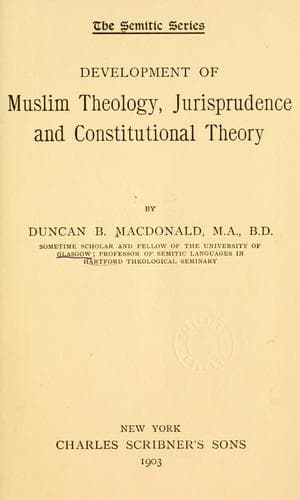
Development of Muslim Theology, Jurisprudence, and Constitutional TheoryMacDonald, Duncan Black
ReligionIslamic
Development of Muslim Theology, Jurisprudence, and Constitutional Theory
MacDonald, Duncan Black
Constitutional law (Islamic law); Islam -- Doctrines -- History; Islam and state -- History; Islamic law -- History
At last, he took the final and fatal step. In 202 a decree appeared
proclaiming the doctrine of the creation of the Qur’an as the only
truth, and as binding upon all Muslims. At the same time, as an evident
sop to the Persian nationalists and the Alids, Ali was proclaimed the
best of creatures after Muhammad. The Alids, it should be remembered,
had close points of contact with the Mu‘tazilites. Such a theological
decree as this was a new thing in Islam; never before had the individual
consciousness been threatened by a word from the throne. The Mu‘tazilites
through it practically became a state church under erastian control. But
the system of Islam never granted to the Imam, or leader of the Muslim
people, any position but that of a protector and representative. Its
theology could only be formed, as we have seen in the case of its law,
by the agreement of the whole community. The question then naturally
was what effect such a new thing as this decree could have except to
exasperate the orthodox and the masses. Practically, there was no other
effect. Things went on as before. All that it meant was that one very
prominent Muslim had stated his opinion and thrown in his lot with
heretics.
For six years this continued, and then a method was devised of bringing
the will of the Khalifa home upon the people. In 217 a distinguished
Mu‘tazilite, Ahmad ibn Abi Duwad, was appointed chief qadi, and in 218
the decree was renewed. But this time it was accompanied by what we would
call a test-act, and an inquisition (_mihna_) was instituted. The letter
of directions for the conduct of this matter, written by al-Ma’mun to his
lieutenant at Baghdad, is decisive as to the character of the man and the
nature of the movement. It is full of railings against the common people
who know not the law and are accursed. They are too stupid to understand
philosophy or argument. It is the duty of the Khalifa to guide them and
especially to show them the distinction between God and His book. He who
holds otherwise than the Khalifa is either too blind or too lying and
deceitful to be trusted in any other thing. Therefore, the qadis must
be tested as to their views. If they hold that the Qur’an is uncreated,
they have abandoned _tawhid_, the doctrine of God’s Unity, and can no
longer hold office in a Muslim land. Also, the qadis must apply the same
test to all the witnesses in cases before them. If these do not hold that
the Qur’an is created, they cannot be legal witnesses. Other letters
followed; the Mihna was extended through the Abbasid empire and applied
to other doctrines, _e.g._, that of free-will and of the vision of God.
The Khalifa also commanded that the death penalty for unbelief (_kufr_)
should be inflicted on those who refused to take the test. They were to
be regarded as idolaters and polytheists. The death of al-Ma’mun in the
same year relieved the pressure. It is true that the Mihna was continued
Public-domain text, read in full here on John Shaqi.
Reviews
Reviews
No reviews yet
Be the first to share your thoughts on this work.
Elsewhere in the archive
Join the Discussion
Join the discussion
Sign in to leave a comment or review.
Sign InorCreate an account