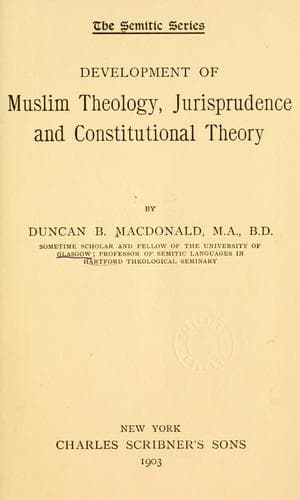
Development of Muslim Theology, Jurisprudence, and Constitutional TheoryMacDonald, Duncan Black
ReligionIslamic
Development of Muslim Theology, Jurisprudence, and Constitutional Theory
MacDonald, Duncan Black
Constitutional law (Islamic law); Islam -- Doctrines -- History; Islam and state -- History; Islamic law -- History
In the case of these and all the others already spoken of there was
nothing but a very simple and natural development such as could easily
be paralleled in Europe. The earliest Muslims were burdened, as we have
seen, with the fear of the terrors of an avenging God. The world was
evil and fleeting; the only abiding good was in the other world; so
their religion became an ascetic other-worldliness. They fled into the
wilderness from the wrath to come. Wandering, either solitary or in
companies, was the special sign of the true Sufi. The young men gave
themselves over to the guidance of the older men; little circles of
disciples gathered round a venerated Shaykh; fraternities began to form.
So we find it in the case of al-Junayd, so in that of Sari as-Saqati.
Next would come a monastery, rather a rest-house; for only in the winter
and for rest did they remain fixed in a place for any time. Of such a
monastery there is a trace at Damascus in 150 and in Khurasan about
200. Then, just as in Europe, begging friars organized themselves. In
faith they were rather conservative than anything else; touched with a
religious passivism which easily developed into quietism. Their ecstasies
went little beyond those, for instance, of Thomas à Kempis, though struck
with a warmer oriental fervor.
The points on which the doctors of Islam took exception to these earlier
Sufis are strikingly different from what we would expect. They concern
the practical life far more than theological speculation. As was natural
in the case of professional devotees, a constantly prayerful attitude
began to assume importance beside and in contrast to the formal use
of the five daily prayers, the _salawat_. This development was in all
probability aided by the existence in Syria of the Christian sect of
the Euchites, who exalted the duty of prayer above all other religious
obligations. These, also, abandoned property and obligations and wandered
as poor brethren over the country. They were a branch of Hesychasts, the
quietistic Greek monks who eventually led to the controversy concerning
the uncreated light manifested at the transfiguration on Mount Tabor and
added a doctrine to the Eastern Church. Considering these points, it can
hardly be doubted that there was some historical connection and relation
here, not only with earlier but also with later Sufiism. There is a
striking resemblance between the Sufis seeking by patient introspection
to see the actual light of God’s presence in their hearts, and the Greek
monks in Athos, sitting solitarily in their cells and seeking the divine
light of Mount Tabor in contemplation of their navels.
Public-domain text, read in full here on John Shaqi.
Reviews
Reviews
No reviews yet
Be the first to share your thoughts on this work.
Elsewhere in the archive
Join the Discussion
Join the discussion
Sign in to leave a comment or review.
Sign InorCreate an account