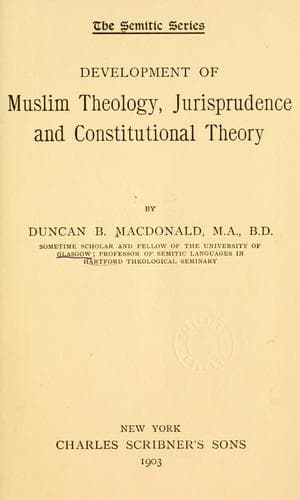
Development of Muslim Theology, Jurisprudence, and Constitutional TheoryMacDonald, Duncan Black
ReligionIslamic
Development of Muslim Theology, Jurisprudence, and Constitutional Theory
MacDonald, Duncan Black
Constitutional law (Islamic law); Islam -- Doctrines -- History; Islam and state -- History; Islamic law -- History
But soon the recoil came. Under the spur of such exercises and thoughts,
the ecstatic oriental temperament began to revel in expressions borrowed
from human love and earthly wine. Such we find by Ma‘ruf of al-Karkh, a
district of Baghdad, who died in 200, and whose tomb, saved by popular
reverence, is one of the few ancient sites in modern Baghdad; and by
his greater disciple, Sari as-Saqati, who died in 257. To this last is
ascribed, but dubiously, the first use of the word _tawhid_ to signify
the union of the soul with God. The figure that the heart is a mirror to
image back God and that it is darkened by the things of the body appears
in Abu Sulayman of Damascus, who died in 215. A more celebrated ascetic,
who died in 227, Bishr al-Hafi (bare-foot), speaks of God directly as the
Beloved (_habib_). Al-Harith al-Muhasibi was a contemporary of Ahmad ibn
Hanbal and died in 243. The only thing in him to which Ahmad could take
exception was that he made use of _kalam_ in refuting the Mu‘tazilites;
even this suspicion against him he is said to have abandoned. Sari and
Bishr, too, were close friends of Ahmad’s. Dhu-n-Nun, the Egyptian Sufi,
who died in 245, is in more dubious repute. He is said to have been the
first to formulate the doctrine of ecstatic states (_hals_, _maqamas_);
but if he went no further than this, his orthodoxy, in the broad sense,
should be above suspicion. Islam has now come to accept these as right
and fitting. Perhaps the greatest name in early Sufiism is that of
al-Junayd (d. 297); on it no shadow of heresy has ever fallen. He was
a master in theology and law, reverenced as one of the greatest of
the early doctors. Questions of _tawhid_ he is said to have discussed
before his pupils with shut doors. But this was probably _tawhid_ in the
theological and not in the mystical sense—against the Mu‘tazilites and
not on the union of the soul with God. Yet he, too, knew the ecstatic
life and fell fainting at verses which struck into his soul. Ash-Shibli
(d. 334) was one of his disciples, but seems to have given himself more
completely to the ascetic and contemplative life. In verses by him we
find the vocabulary of the amorous intercourse with God fully developed.
The last of this group to be mentioned here shall be Abu Talib al-Makki,
who died in 386. It is his distinction to have furnished a text-book
of Sufiism that is in use to this day. He wrote and spoke openly on
_tawhid_, now in the Sufi sense, and got into trouble as a heretic, but
his memory has been restored to orthodoxy by the general agreement of
Islam. When, in 488, al-Ghazzali set himself to seek light in Sufiism,
among the treatises he studied were the books of four of those mentioned
above, Abu Talib, al-Muhasibi, al-Junayd, and ash-Shibli.
[Sidenote: GROWTH OF FRATERNITIES]
Public-domain text, read in full here on John Shaqi.
Reviews
Reviews
No reviews yet
Be the first to share your thoughts on this work.
Elsewhere in the archive
Join the Discussion
Join the discussion
Sign in to leave a comment or review.
Sign InorCreate an account