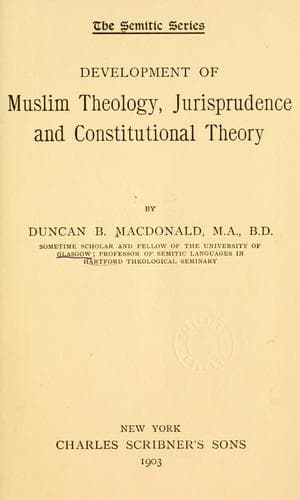
Development of Muslim Theology, Jurisprudence, and Constitutional TheoryMacDonald, Duncan Black
ReligionIslamic
Development of Muslim Theology, Jurisprudence, and Constitutional Theory
MacDonald, Duncan Black
Constitutional law (Islamic law); Islam -- Doctrines -- History; Islam and state -- History; Islamic law -- History
To this it may be imagined that the more sober, even among Sufis, made
vehement objection. It fell under two heads. One was that of _kasb_,
the gaining of daily bread by labor. The examples of the husbandman who
casts his seed into the ground and then depends upon God, of the merchant
who travels with his wares in similar trust, were held up against the
wandering but useless monk. As always, traditions were forged on both
sides. Said a man—apparently in a spirit of prophecy—one day to the
Prophet, “Shall I let my camel run free and trust in God?” Replied
the Prophet, or someone for him with a good imitation of his humorous
common-sense, “Tie up your camel and trust in God.” The other head
was the use of remedies in sickness. The whole controversy parallels
strikingly the “mental science” and “Christian science” of the present
day. Medicine, it was held, destroyed _tawakkul_. In the fourth century
in Persia this insanity ran high and many books were written for it and
against it. The author of one on the first side was consulted in an
obstinate case of headache. “Put my book under your pillow,” he said,
“and trust in God.” On both these points the usage of the Prophet and the
Companions was in the teeth of the Sufi position. They had notoriously
earned their living, honestly or dishonestly, and had possessed all the
credulity of semi-civilization toward the most barbaric and multifarious
remedies. So the agreement of Islam eventually righted itself, though the
question in its intricacies and subtilties remained for centuries a thing
of delight for theologians. In the end only the wildest fanatics held by
absolute _tawakkul_.
[Sidenote: SPECULATIVE SUFIISM]
Public-domain text, read in full here on John Shaqi.
Reviews
Reviews
No reviews yet
Be the first to share your thoughts on this work.
Elsewhere in the archive
Join the Discussion
Join the discussion
Sign in to leave a comment or review.
Sign InorCreate an account