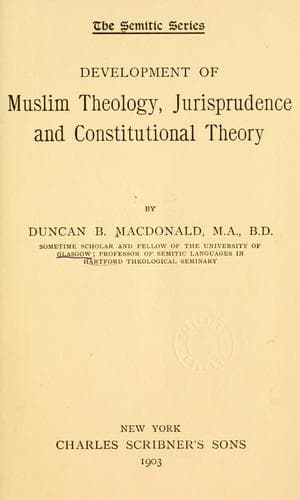
Development of Muslim Theology, Jurisprudence, and Constitutional TheoryMacDonald, Duncan Black
ReligionIslamic
Development of Muslim Theology, Jurisprudence, and Constitutional Theory
MacDonald, Duncan Black
Constitutional law (Islamic law); Islam -- Doctrines -- History; Islam and state -- History; Islamic law -- History
But all this time the second form of Sufiism had been slowly forcing its
way. It was essentially speculative and theological rather than ascetic
and devotional. When it gained the upper hand, _zahid_ (ascetic) was no
longer a convertible term with Sufi. We pass over the boundary between
Thomas à Kempis and St. Francis to Eckhart and Suso. The roots of this
movement cannot be hard to find in the light of what has preceded.
They lie partly in the neo-Platonism which is the foundation of the
philosophy of Islam. Probably it did not come to the Sufis along the
same channels by which it reached al-Farabi. It was rather through the
Christian mystics and, perhaps, especially through the Pseudo-Dionysius
the Areopagite, and his asserted teacher, Stephen bar Sudaili with his
Syriac “Book of Hierotheos.” We need not here consider whether the
Monophysite heresy is to be reckoned in as one of the results of the
dying neo-Platonism. It is true that outlying forms of it meant the
frank deifying of a man and thus raised the possibility of the equal
deifying of any other man and of all men. But there is no certainty that
these views had an influence in Islam. It is enough that from A.D. 533
we find the Pseudo-Dionysius quoted and his influence strong with the
ultra Monophysites, and still more, thereafter, with the whole mystical
movement in Christendom. According to it, all is akin in nature to the
Absolute, and all this life below is only a reflection of the glories of
the upper sphere, where God is. Through the sacraments and a hierarchy
of angels man is led back toward Him. Only in ecstasy can man come to a
knowledge of Him. The Trinity, sin and the atonement fade out of view.
The incarnation is but an example of how the divine and the human can
join. All is an emanation or an emission of grace from God; and the
yearnings of man are back to his source. The revolving spheres, the
groaning and travailing nature are striving to return to their origin.
When this conception had seized the Oriental Church; when it had passed
into Islam and dominated its emotional and religious life; when through
the translation of the Pseudo-Dionysius by Scotus Erigena in 850, it had
begun the long contest of idealism in Europe, the dead school of Plotinus
had won the field, and its influence ruled from the Oxus to the Atlantic.
Public-domain text, read in full here on John Shaqi.
Reviews
Reviews
No reviews yet
Be the first to share your thoughts on this work.
Elsewhere in the archive
Join the Discussion
Join the discussion
Sign in to leave a comment or review.
Sign InorCreate an account