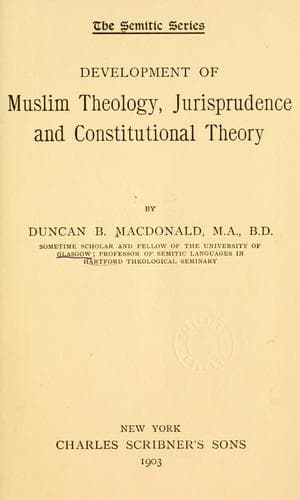
Development of Muslim Theology, Jurisprudence, and Constitutional TheoryMacDonald, Duncan Black
ReligionIslamic
Development of Muslim Theology, Jurisprudence, and Constitutional Theory
MacDonald, Duncan Black
Constitutional law (Islamic law); Islam -- Doctrines -- History; Islam and state -- History; Islamic law -- History
subtilties.
CHAPTER III
The rise of orthodox _kalam_; al-Ash‘ari; decline of the
Mu‘tazilites; passing of heresy into unbelief; development of
scholastic theology by Ash‘arites; rise of Zahirite _kalam_;
Ibn Hazm; persecution of Ash‘arites; final assimilation of
_kalam_.
As we have already seen, the traditionalist party at first refused to
enter upon any discussion of sacred things. Malik ibn Anas used to say,
“God’s _istiwa_ (settling Himself firmly upon His throne) is known;
how it is done is unknown; it must be believed; questions about it are
an innovation (_bid‘a_).” But such a position could not be held for
any length of time. The world cannot be cut in two and half assigned
to faith and half to reason. So, as time went on, there arose on the
orthodox side men who, little by little, were prepared to give a reason
for the faith that was in them. They thus came to use _kalam_ in order
to meet the _kalam_ of the Mu‘tazilites; they became _mutakallims_, and
the scholastic theology of Islam was founded. It is the history of this
transfer of method which we have now to consider.
[Sidenote: RISE OF ORTHODOX KALAM]
Its beginnings are wrapped in a natural obscurity. It was at first a
gradual, unconscious drift, and people did not recognize its existence.
Afterward, when they looked back upon it, the tendency of the human
mind to ascribe broad movements to single men asserted itself and the
whole was put under the name of al-Ash‘ari. It is true that with him,
in a sense, the change suddenly leaped to self-consciousness, but it
had already been long in progress. As we have seen, al-Junayd discussed
the unity of God, but it was behind closed doors. Ash-Shafi‘i held that
there should be a certain number of men trained thus to defend and purify
the faith, but that it would be a great evil if their arguments should
become known to the mass of the people. Al-Muhasibi, a contemporary of
Ahmad ibn Hanbal, was suspected, and rightly, of defending his faith with
argument, and thereby incurred Ahmad’s displeasure. Another contemporary
of Ahmad’s, al-Karabisi (d. 345), incurred the same displeasure, and the
list might easily be extended. But the most significant fact of all is
that the movement came to the surface and showed itself openly at the
same time in the most widely separated lands of Islam. In Mesopotamia
there was al-Ash‘ari, who died after 320; in Egypt there was at-Tahawi,
who died in 331; in Samarqand there was al-Mataridi, who died in 333. Of
these at-Tahawi is now little more than a name; al-Mataridi’s star has
paled before that of al-Ash‘ari; al-Ash‘ari has come in popular view to
be the solitary hero before whom the Mu‘tazilite system went down. It
will perhaps be sufficient if we take his life and experiences as our
guide in this period of change; the others must have followed very much
in the same path.
Public-domain text, read in full here on John Shaqi.
Reviews
Reviews
No reviews yet
Be the first to share your thoughts on this work.
Elsewhere in the archive
Join the Discussion
Join the discussion
Sign in to leave a comment or review.
Sign InorCreate an account