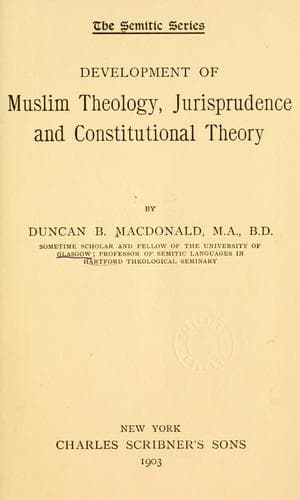
Development of Muslim Theology, Jurisprudence, and Constitutional TheoryMacDonald, Duncan Black
ReligionIslamic
Development of Muslim Theology, Jurisprudence, and Constitutional Theory
MacDonald, Duncan Black
Constitutional law (Islamic law); Islam -- Doctrines -- History; Islam and state -- History; Islamic law -- History
But the greatest name of all among these early pantheists was that of
al-Hallaj (the cotton carder), a pupil of al-Junayd, who was put to
death with great cruelty in 309. It is almost impossible to reach any
certain conclusion as to his real views and aims. In spite of what seem
to be utterances of the crassest pantheism, such as, “I am the Truth,”
there have not been wanting many in later Islam who have reverenced his
memory as that of a saint and martyr. To Sufis and darwishes of his
time and to this day he has been and is a patron saint. In his life
and death he represents for them the spirit of revolt against dogmatic
scholasticism and formalism. Further, even such a great doctor of the
Muslim Church as al-Ghazzali defended him and, though lamenting some
incautious phrases, upheld his orthodoxy. At his trial itself before
the theologians of Baghdad, one of them refused to sign the _fatwa_
declaring him an unbeliever; he was not clear, he said, as to the case.
And it is true that such records as we have of the time suggest that his
condemnation was forced by the government as a matter of state policy. He
was a Persian of Magian origin, and evidently an advanced mystic of the
speculative type. He carried the theory to its legitimate conclusion, and
proclaimed the result publicly. He dabbled in scholastic theology; had
evident Mu‘tazilite leanings; wrote on alchemy and things esoteric. But
with this mystical enthusiasm there seem to have united in him other and
more dangerous traits. The stories which have reached us show him of a
character fond of excitement and change, surrounding himself with devoted
adherents and striving by miracle-working of a commonplace kind to add
to his following. His popularity among the people of Baghdad and their
reverence for him rose to a perilous degree. He may have had plans of his
own as a Persian nationalist; he may have had part in one of the Shi‘ite
conspiracies; he may have been nothing but a rather weak-headed devotee,
carried off his feet by a sudden tide of public excitement, the greatest
trial and danger that a saint has to meet. But the times were not such
then in Baghdad that the government could take any risks. Al-Muqtadir
was Khalifa and in his weak hands the Khalifate was slipping to ruin.
The Fatimids were supreme in North Africa; the Qarmatians held Syria and
Arabia, and were threatening Baghdad itself. In eight years they were to
take Mecca. Persia was seething with false prophets and nationalists of
every shade. Thirteen years later Ibn ash-Shalmaghani was put to death
in Baghdad on similar grounds; in his case, Shi‘ite conspiracy against
the state was still more clearly involved. We can only conclude in the
words of Ibn Khallikan (d. 681), “The history of al-Hallaj is long to
relate; his fate is well known; and God knoweth all secret things.” With
him we must leave, for the present, consideration of the Sufi development
and return to the Mu‘tazilites and to the people tiring of their dry
Public-domain text, read in full here on John Shaqi.
Reviews
Reviews
No reviews yet
Be the first to share your thoughts on this work.
Elsewhere in the archive
Join the Discussion
Join the discussion
Sign in to leave a comment or review.
Sign InorCreate an account