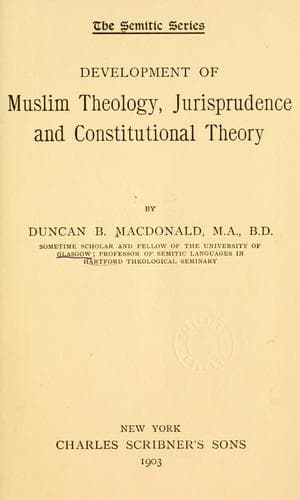
Development of Muslim Theology, Jurisprudence, and Constitutional TheoryMacDonald, Duncan Black
ReligionIslamic
Development of Muslim Theology, Jurisprudence, and Constitutional Theory
MacDonald, Duncan Black
Constitutional law (Islamic law); Islam -- Doctrines -- History; Islam and state -- History; Islamic law -- History
It can easily be seen that in some such way as this the blood of the race
may have led him back to the God of his fathers, the God of the desert,
whose word must be accepted as its own proof. The gossips of the time
told strange tales of rich relatives and family pressure; we can leave
these aside. When he had changed he was terribly in earnest. He met his
old teacher, al-Jubba‘i, in public discussions again and again till the
old man withdrew. One of these discussions legend has handed down in
varying forms. None of them may be exactly true, but they are significant
of the change of attitude. He came to al-Jubba‘i and said, “Suppose the
case of three brothers; one being God-fearing, another godless and a
third dies as a child. What of them in the world to come?” Al-Jubba‘i
replied, “The first will be rewarded in Paradise; the second punished in
Hell, and the third will be neither rewarded nor punished.” Al-Ash‘ari
continued, “But if the third said, ‘Lord, Thou mightest have granted
me life, and then I would have been pious and entered Paradise like my
brother,’ what then?” Al-Jubba‘i replied, “God would say, ‘I knew that if
thou wert granted life thou wouldst be godless and unbelieving and enter
Hell.’” Then al-Ash‘ari drew his noose, “But what if the second said,
‘Lord, why didst Thou not make me die as a child? Then had I escaped
Hell.’” Al-Jubba‘i was silenced, and Al-Ash‘ari went away in triumph.
Three years after his pupil had left him the old man died. The tellers
of this story regard it as disproving the Mu‘tazilite doctrine of “the
best”—_al-aslah_—namely, that God is constrained to do that which may be
best and happiest for His creatures. Orthodox Islam, as we have seen,
holds that God is under no such constraint, and is free to do good or
evil as He chooses.
But the story has also another and somewhat broader significance. It is a
protest against the religious rationalism of the Mu‘tazilites, which held
that the mysteries of the universe could be expressed and met in terms
of human thought. In this way it represents the essence of al-Ash‘ari’s
position, a recoil from the impossible task of raising a system of
purely rationalistic theology to reliance upon the Word of God, and the
tradition (_hadith_) and usage (_sunna_) of the Prophet and the pattern
of the early church (_salaf_).
Public-domain text, read in full here on John Shaqi.
Reviews
Reviews
No reviews yet
Be the first to share your thoughts on this work.
Elsewhere in the archive
Join the Discussion
Join the discussion
Sign in to leave a comment or review.
Sign InorCreate an account