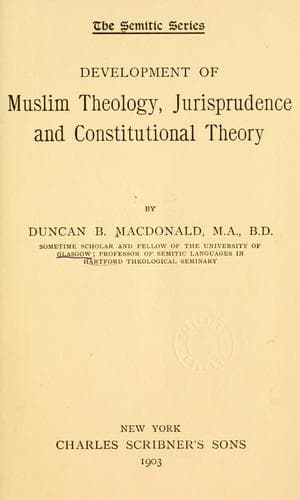
Development of Muslim Theology, Jurisprudence, and Constitutional TheoryMacDonald, Duncan Black
ReligionIslamic
Development of Muslim Theology, Jurisprudence, and Constitutional Theory
MacDonald, Duncan Black
Constitutional law (Islamic law); Islam -- Doctrines -- History; Islam and state -- History; Islamic law -- History
The stories told above represent the change as sudden. According to the
evidence of his books that was not so. In his return there were two
stages. In the first of these he upheld the seven rational Qualities
(_sifat aqliya_) of God, Life, Knowledge, Power, Will, Hearing, Seeing,
Speech: but explained away the Qur’anic anthropomorphisms of God’s
face, hands, feet, etc. In the second stage, which fell, apparently,
after he had moved to Baghdad and come under the strong Hanbalite
influences there, he explained away nothing, but contented himself with
the position that the anthropomorphisms were to be taken, _bila kayfa
wala tashbih_, without asking how and without drawing any comparison.
The first phrase is directed against the Mu‘tazilites, who inquired
persistently into the nature and possibility of such things in God;
the second, against the anthropomorphists (_mushabbihs_, comparers;
_mujassims_, corporealizers), mostly ultra Hanbalites and Karramites, who
said that these things in God were like the corresponding things in men.
At all stages, however, he was prepared to defend his conclusions and
assail those of his adversaries by dint of argument.
[Sidenote: SYSTEM OF AL-ASH‘ARI]
The details of his system will be best understood by reading his creed
and the creed of al-Fudali, which is essentially Ash‘arite. Both are
in the Appendix of Translated Creeds. Here, it is necessary to draw
attention to two, only, of the obscurer points. On the vexed question,
“What is a thing?” he anticipated Kant. The early theologians, orthodox
and theoretical, and those later ones also who did not follow him,
regarded, as we have seen, existence (_wujud_) as only one of the
qualities belonging to an existing thing (_mawjud_). It was there all the
time, but it lacked the quality of “existence”; then that quality was
added to its other qualities and it became existent. But al-Ash‘ari and
his followers held that existence was the “self” (_ayn_) of the entity
and not a quality or state, however personal or necessary. See, on the
whole, Appendix of Creeds.
Public-domain text, read in full here on John Shaqi.
Reviews
Reviews
No reviews yet
Be the first to share your thoughts on this work.
Elsewhere in the archive
Join the Discussion
Join the discussion
Sign in to leave a comment or review.
Sign InorCreate an account