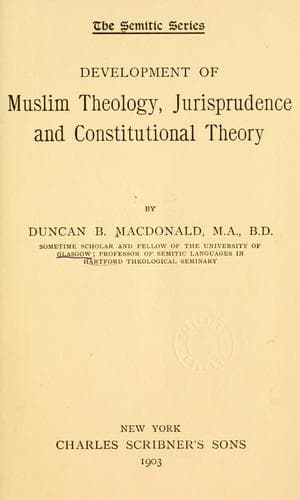
Development of Muslim Theology, Jurisprudence, and Constitutional TheoryMacDonald, Duncan Black
ReligionIslamic
Development of Muslim Theology, Jurisprudence, and Constitutional Theory
MacDonald, Duncan Black
Constitutional law (Islamic law); Islam -- Doctrines -- History; Islam and state -- History; Islamic law -- History
They lacked the necessary knowledge of the
subject, had no scientific basis, and were constrained eventually to fall
back on authority. After study of them and their methods it became clear
to al-Ghazzali that the remedy for his ailment was not in scholastic
theology.
[Sidenote: MATERIALISTS; DEISTS; THEISTS]
Then he turned to philosophy. He had seen already that the weakness
of the theologians lay in their not having made a sufficient study of
primary ideas and the laws of thought. Three years he gave up to this.
He was at Baghdad at the time, teaching law and writing legal treatises,
and probably the three years extended from the beginning of 484 to the
beginning of 487. Two years he gave, without a teacher, to the study of
the writings of the different schools of philosophy, and almost another
to meditating and working over his results. He felt that he was the
first Muslim doctor to do this with the requisite thoroughness. And it
is noteworthy that at this stage he seems to have again felt himself to
be a Muslim, and in an enemy’s country when he was studying philosophy.
He speaks of the necessity of understanding what is to be refuted; but
this may be only a confusion between his attitude when writing after
500, and his attitude when investigating and seeking truth, fifteen
years earlier. He divides the followers of philosophy in his time into
three: Materialists, Deists (_Tabi‘is, i.e._ Naturalists), and Theists.
The materialists reject a creator; the world exists from all eternity;
the animal comes from the egg and the egg from the animal. The wonder
of creation compels the deists to admit a creator, but the creature is
a machine, has a certain poise (_i‘tidal_) in itself which keeps it
running; its thought is a part of its nature and ends with death. They
thus reject a future life, though admitting God and His attributes.
He deals at much greater length with the teachings of those whom he calls
theists, but through all his statements of their views his tone is not
that of a seeker but that of a partisan; he turns his own experiences
into a warning to others, and makes of their record a little guide to
apologetics. Aristotle he regards as the final master of the Greek
school; his doctrines are best represented for Arabic readers in the
books of Ibn Sina and al-Farabi; the works of their predecessors on this
subject are a mass of confusion. Part of these doctrines must be stamped
as unbelief, part as heresy, and part as theologically indifferent. He
then divides the philosophical sciences into six, mathematics, logic,
physics, metaphysics, political economy, ethics; and discusses these in
detail, showing what must be rejected, what is indifferent, what dangers
arise from each to him who studies or to him who rejects without study.
Public-domain text, read in full here on John Shaqi.
Reviews
Reviews
No reviews yet
Be the first to share your thoughts on this work.
Elsewhere in the archive
Join the Discussion
Join the discussion
Sign in to leave a comment or review.
Sign InorCreate an account