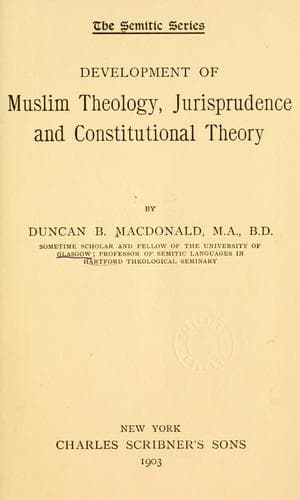
Development of Muslim Theology, Jurisprudence, and Constitutional TheoryMacDonald, Duncan Black
ReligionIslamic
Development of Muslim Theology, Jurisprudence, and Constitutional Theory
MacDonald, Duncan Black
Constitutional law (Islamic law); Islam -- Doctrines -- History; Islam and state -- History; Islamic law -- History
At last, the strain became too great and at the court of Nizam al-Mulk he
touched for two months the depths of absolute scepticism. He doubted the
evidence of the senses; he could see plainly that they often deceived. No
eye could perceive the movement of a shadow, but still the shadow moved;
a gold piece would cover any star, but a star was a world larger than the
earth. He doubted even the primary ideas of the mind. Is ten more than
three? Can a thing be and not be? Perhaps; he could not tell. His senses
deceived him, why not his mind? May there not be something behind the
mind and transcending it, which would show the falsity of its convictions
even as the mind showed the falsity of the information given by the
senses? May not the dreams of the Sufis be true, and their revelations
in ecstasy the only real guides? When we awake in death, may it not be
into a true but different existence? All this—perhaps. And so he wandered
for two months. He saw clearly that no reasoning could help him here; he
had no ideas on which he could depend, from which he could begin. But the
mercy of God is great; He sends His light to whom He wills, a light that
flows in, and is given by no reasoning. By it al-Ghazzali was saved; he
regained the power to think, and the task which he now set before him was
to use this power to guide himself to truth.
[Sidenote: THE SEEKERS OF HIS TIME]
When he looked around, he saw that those who gave themselves to the
search for truth might be divided into four groups. There were the
scholastic theologians, who were much like the theologians of all times
and faiths. Second, there were the Ta‘limites, who held that to reach
truth one must have an infallible living teacher, and that there was
such a teacher. Third, there were the followers of philosophy, basing
on logical and rational proofs. Fourth, there were the Sufis, who held
that they, the chosen of God, could reach knowledge of Him directly in
ecstasy. With all these he had, of course, been acquainted to a greater
or less degree; but now he settled down to examine them one by one, and
find which would lead him to a certainty to which he could hold, whatever
might come. He felt that he could not go back to the unconscious faith of
his childhood; _that_ nothing could restore. All his mental being must be
made over before he could find rest. He began with scholastic theology,
but found no help there. Grant the theologians their premises and they
could argue; deny them and there was no common ground on which to meet.
Their science had been founded by al-Ash‘ari to meet the Mu‘tazilites;
it had done that victoriously, but could do no more. They could hold the
faith against heretics, expose their inconsistencies; against the sceptic
they availed nothing. It is true that they had attempted to go further
back and meet the students of philosophy on their own ground; to deal
with substances and attributes and first principles generally; but their
efforts had been fruitless.
Public-domain text, read in full here on John Shaqi.
Reviews
Reviews
No reviews yet
Be the first to share your thoughts on this work.
Elsewhere in the archive
Join the Discussion
Join the discussion
Sign in to leave a comment or review.
Sign InorCreate an account