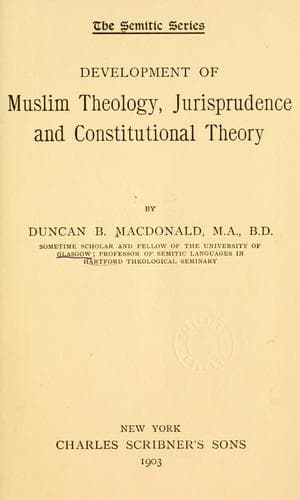
Development of Muslim Theology, Jurisprudence, and Constitutional TheoryMacDonald, Duncan Black
ReligionIslamic
Development of Muslim Theology, Jurisprudence, and Constitutional Theory
MacDonald, Duncan Black
Constitutional law (Islamic law); Islam -- Doctrines -- History; Islam and state -- History; Islamic law -- History
But where he absolutely parted company from the Ash‘arites was with
regard to the qualities of God. In that, too, he followed the view
of Ibn Hazm sketched above. We must take the Qur’anic expressions
as names and not as indicating attributes to us. It is true that his
creed shows signs of a philosophical width lacking in Ibn Hazm. Like
the Mu‘tazilites, _e.g._ Abu Hudhayl, he defines largely by negations.
God is not this; is not affected by that. It is even phrased so as to
be capable of a pantheistic explanation, and we find that Ibn Rushd
wrote a commentary on it. But it may be doubted whether Ibn Tumart was
himself a pantheist. All phases of Islam, as we have seen, ran toward
that; and here there is only a little indiscretion in the wording. But
it may easily have been that he had besides, like the Fatimids, a secret
teaching or exposition of those simpler declarations which were intended
for the mass of the people. Among his successors distinct traces of
such a thing appear; both Aristotelian philosophers and advanced Sufis
are connected with the Muwahhid movement. That, however, belongs to the
sequel.
The success of Ibn Tumart, if halting at first, was eventually complete.
As a simple lawyer who felt called upon to protest—as, indeed, are all
good Muslims in virtue of a tradition from Muhammad—against the abuses
of the time, he accomplished comparatively little. As Mahdi, he and
his supporter and successor, Abd al-Mu’min, swept the country. For his
movement was not merely Imamite and Muslim, but an expression as well of
Berber nationalism. Here was a man, sprung from their midst, of their
own stock and tongue, who, as Prophet of God, called them to arms. They
obeyed his call, worshipped him and fought for him. He translated the
Qur’an for them into Berber; the call to prayers was given in Berber;
functionaries of the church had to know Berber; his own theological
writings circulated in Berber as well as in Arabic. As Persia took Islam
and moulded it to suit herself, so now did the Berber tribes. And a
strange jumble they made of it. With them, the Zahirite system of canon
law, rejected by all other Muslim peoples, enjoyed its one brief period
of power and glory. Shi‘ite legends and superstitions mingled with
philosophical free thought. The book of mystery, _al-Jafr_, written by
Ali, and containing the history of the world to the end of time, was said
to have passed from the custody of al-Ghazzali at his death to the hands
of the Mahdi and was by him committed to his successors. If only in view
of the syncretism practised by both, it was fitting that al-Ghazzali and
Ibn Tumart should be brought closely together. Yet it is hard to explain
the persistence with which the great Ash‘arite is made the teacher and
guide of the semi-Zahirite. There must have been something, now obscure
to us, in their respective systems which suggested to contemporaries such
intimate connection.
Public-domain text, read in full here on John Shaqi.
Reviews
Reviews
No reviews yet
Be the first to share your thoughts on this work.
Elsewhere in the archive
Join the Discussion
Join the discussion
Sign in to leave a comment or review.
Sign InorCreate an account