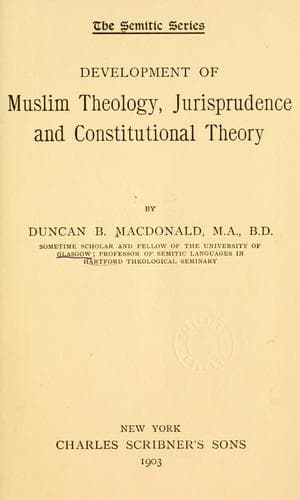
Development of Muslim Theology, Jurisprudence, and Constitutional TheoryMacDonald, Duncan Black
ReligionIslamic
Development of Muslim Theology, Jurisprudence, and Constitutional Theory
MacDonald, Duncan Black
Constitutional law (Islamic law); Islam -- Doctrines -- History; Islam and state -- History; Islamic law -- History
Ibn Tumart started in life as a reformer of the corruptions of his
day, and seems to have slipped from that into the belief that he had
been appointed by God as the great reformer for all time. As happens
with reformers, from exhortation it came to force; from preaching at
the abuses of the government to rebellion against the government. That
government, the Murabit, went down before Ibn Tumart and his successors,
and the pontifical rule of the Muwahhids, the asserters of God’s
_tawhid_ or unity, rose in its place. The doctrine which he preached
bears evident marks of the influence of al-Ghazzali and of Ibn Hazm.
_Tawhid_, for him, meant a complete spiritualizing of the conception of
God. Opposed to _tawhid_, he set _tajsim_, the assigning to God of a
_jism_ or body having bulk. Thus, when the theologians of the West took
the anthropomorphic passages of the Qur’an literally, he applied to them
the method of _ta’wil_, or interpretation, which he had learned in the
East, and explained away these stumbling-blocks. Ibn Hazm, it will be
remembered, resorted to grammatical and lexicographical devices to attain
the same end, and had regarded _ta’wil_ with abhorrence. To Ibn Tumart,
then, this _tajsim_ was flat unbelief and, as Mahdi, it was his duty to
oppose it by force of arms, to lead a _jihad_ against its maintainers.
Further, with Ibn Hazm, he agreed in rejecting _taqlid_. There was only
one truth, and it was man’s duty to find it for himself by going to the
original sources. This is the genuine Zahirite doctrine which utterly
rejects all comity with the four other legal rites; but Ibn Tumart,
as Mahdi, added another element. It is based on a very simple Imamite
philosophy of history. There has always been an Imam in the world, a
divinely appointed leader, guarded by _isma_, protection against error.
The first four Khalifas were of such divine appointment; thereafter came
usurpers and oppressors. Theirs was the reign of wickedness and lies in
the earth. Now he, the Mahdi, was come of the blood of the Prophet and
bearing plainly all the necessary, accrediting signs to overcome these
tyrants and anti-Christs. He thus was an Imamite, but stood quite apart
from the welter of conflicting Shi‘ite sects—the Seveners, Twelvers,
Zaydites and the rest—as far as do the present Sharifs of Morocco with
their Alid-Sunnite position. The Mahdi, it is to be remembered, is
awaited by Sunnites as by Shi‘ites, and is guarded against error as much
as an Imam, since he partakes of the general _isma_ which in divine
things belongs to prophets. Such a leader, then, could claim from the
people absolute obedience and credence. His word must be for them the
source of truth. There was, therefore, no longer any need of analogy
(_qiyas_) as a source, and we accordingly find that Ibn Tumart rejected
it in all but legal matters and there surrounded it with restrictions.
Analogical argument in things theological was forbidden.
Public-domain text, read in full here on John Shaqi.
Reviews
Reviews
No reviews yet
Be the first to share your thoughts on this work.
Elsewhere in the archive
Join the Discussion
Join the discussion
Sign in to leave a comment or review.
Sign InorCreate an account