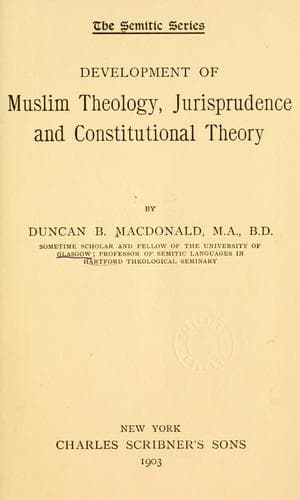
Development of Muslim Theology, Jurisprudence, and Constitutional TheoryMacDonald, Duncan Black
ReligionIslamic
Development of Muslim Theology, Jurisprudence, and Constitutional Theory
MacDonald, Duncan Black
Constitutional law (Islamic law); Islam -- Doctrines -- History; Islam and state -- History; Islamic law -- History
Ibn Bajja was a close disciple of al-Farabi, who is to be regarded as the
spiritual father of the later Arabic philosophy; Ibn Sina practically
falls out. In logic, physics, and metaphysics he followed al-Farabi
closely. But we can see how the times have moved and the philosophies
with them. The essential differences have appeared and Ibn Bajja can no
longer, with a good conscience, appear as a pious Muslim. The Sufi strain
also is much weaker. The greatest joy and the closest truth are to be
found in thought, and not in the sensuous ecstasies of the mystic. The
intellect is the highest element in man’s being, but is only immortal as
it joins itself to the one Active Intellect, which is all that is left of
God. Here we have the beginning of the doctrine which, later, under the
name of Averroism and pampsychism ran like wild-fire through the schools
of Europe. Further, only by the constant exercise of its own functions
can the intellect of man be thus raised. He must live rationally at all
points; be able to give a reason for every action. This may compel him
to live in solitude; the world is so irrational and will not suffer
reason. Or some of the disciples of reason may draw together and form a
community where they may live the calm life of nature and of the pursuit
of knowledge and self-development. So they will be at one with nature and
the eternal, and far removed from the frenzied life of the multitude with
its lower aims and conceptions. It is easy to see how the iron of a fight
against overwhelming odds had entered this soul. Only the friendship of
some of the Murabit princes saved him; but he died in the end, says a
story, by poison.
With the next names we find ourselves at a Muwahhid court, and there the
atmosphere has changed. It is evident that, whatever might be the temper
of the people, the chiefs of the Muwahhids viewed philosophy with no
disfavor. Their problem, as in the case of the Fatimids, seems rather
to have been how much the people might be taught with safety. Their
solution of the problem—here we proceed on conjecture, but the basis is
tolerably sound—was that the bulk of the people should be taught nothing
but the literal sense of the Qur’an, metaphors, anthropomorphisms and
all; that the educated lay public, which had already some inkling of the
facts, should be assured that there was really no difference between
philosophy and theology—that they were two phases of one truth; and that
the philosophers should have a free hand to go on their own way, always
provided that their speculations did not spread beyond their own circle
and agitate the minds of the commonalty. It was a beautiful scheme, but
like all systems of obscurantism it did not work. On the one hand, the
people refused to be blindfolded, and, on the other, philosophy died out
of inanition.
Public-domain text, read in full here on John Shaqi.
Reviews
Reviews
No reviews yet
Be the first to share your thoughts on this work.
Elsewhere in the archive
Join the Discussion
Join the discussion
Sign in to leave a comment or review.
Sign InorCreate an account