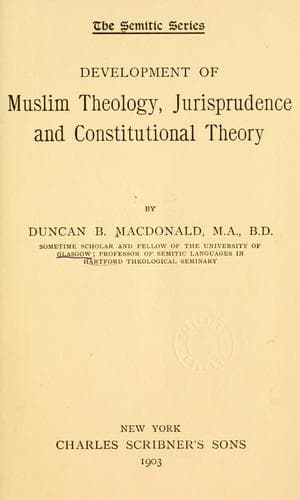
Development of Muslim Theology, Jurisprudence, and Constitutional TheoryMacDonald, Duncan Black
ReligionIslamic
Development of Muslim Theology, Jurisprudence, and Constitutional Theory
MacDonald, Duncan Black
Constitutional law (Islamic law); Islam -- Doctrines -- History; Islam and state -- History; Islamic law -- History
In accordance with this, we find the Muwahhid chiefs installing the
Zahirite _fiqh_ as the official system and sternly stopping all
speculative discussing either of canon law or of theology. “The Word so
stands written; take it or the sword,” is the significant utterance which
has come to us from Abu Ya‘qub (reg. 558-580), son of Abd al-Mu’min. The
same continued under his son Abu Yusuf al-Mansur (reg. 580-595), who
added a not very carefully concealed contempt for the Mahdiship of Ibn
Tumart. All such things were ridiculous in his philosophic eyes.
[Sidenote: IBN TUFAYL; IBN RUSHD]
Under these men and in adjustment with their system lived and worked Ibn
Tufayl and Ibn Rushd, the last of the great Aristotelians. Ibn Tufayl
was wazir and physician to Abu Ya‘qub and died a year after him, in 531.
His was a calm, contemplative life, secluded in princely libraries. But
his objects were the same as those of Ibn Bajja. He has evidently no
hope that the great body of the people can ever be brought to the truth.
A religion, sensuous and sensual alike, is needed to restrain the wild
beast in man, and the masses should be left to the guidance of that
religion. For a philosopher to seek to teach them better is to expose
himself to peril and them to the loss of that little which they have. But
in his methods, on the other hand, Ibn Tufayl is essentially at one with
al-Ghazzali. He is a mystic who seeks in Sufi exercises, in the constant
purifying of mind and body and in the unwearying search for the one unity
in the individual multiplicity around him, to find a way to lose his self
in that eternal and one spirit which for him is the divine. So at last
he comes to ecstasy and reaches those things which eye hath not seen
nor ear heard. The only difference between him and al-Ghazzali is that
al-Ghazzali was a theologian and saw in his ecstasy Allah upon His throne
and around Him the things of the heavens, as set forth in the Qur’an,
while Ibn Tufayl was a philosopher, of neo-Platonic + Aristotelian stamp,
and saw in his ecstasy the Active Intellect and Its chain of causes
reaching down to man and back to Itself.
Public-domain text, read in full here on John Shaqi.
Reviews
Reviews
No reviews yet
Be the first to share your thoughts on this work.
Elsewhere in the archive
Join the Discussion
Join the discussion
Sign in to leave a comment or review.
Sign InorCreate an account