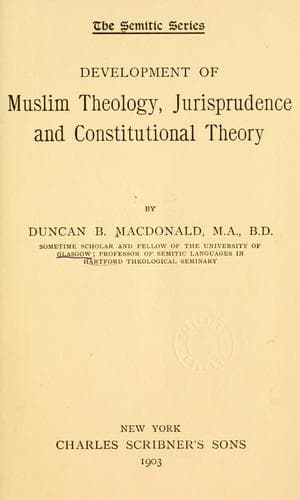
Development of Muslim Theology, Jurisprudence, and Constitutional TheoryMacDonald, Duncan Black
ReligionIslamic
Development of Muslim Theology, Jurisprudence, and Constitutional Theory
MacDonald, Duncan Black
Constitutional law (Islamic law); Islam -- Doctrines -- History; Islam and state -- History; Islamic law -- History
Our sources now begin to grow more and more scanty, and we must hasten
over long intervals of time and pass with little connection from one
name to another. Preliminary investigations are also to a great extent
lacking, and it is possible that the centuries which we shall merely
touch may have witnessed developments only less important than those with
which we have already dealt. But that is not probable; for when, after
a long silence, the curtain rises again for us in the twelfth Muslim
century, we shall find at work only those elements and conditions whose
inception and growth we have now set forth.
One name in our rapid flight deserves mention, at least. It is that of
Umar ibn al-Farid, the greatest poet that Arabic mysticism has produced.
He was born at Cairo in 586, lived for a time at Mecca, and died at Cairo
in 632. He led no new movement or advance, but the East still cherishes
his memory and his poems.
[Sidenote: DARWISH FRATERNITIES]
We have already noticed (p. 177) the beginnings of darwish Fraternities
and the founding of monasteries or _khanqahs_. During the period over
which we have just passed, these received a great and enduring impetus.
The older ascetics and _walis_ gathered round them groups of personal
followers and their pupils carried on their names. But it was long,
apparently, before definite corporations were founded of fixed purpose
to perpetuate the memory of their masters. One of the earliest of these
seems to have been the fraternity of Qadirite darwishes, founded by Abd
al-Qadir al-Jilani, who died in 561 at Baghdad, where pilgrimage is still
made to his shrine. So, too, the Rifa‘ite Fraternity was founded at
Baghdad by Ahmad ar-Rifa‘a in 576. Another is that of the Shadhilites,
named after their founder, ash-Shadhili, who died in 656. Again another
is that of the Badawites, whose founder was Ahmad al-Badawi (d. 675);
his shrine at Tanta in Lower Egypt is still one of the most popular
places of pilgrimage. Again, the order of the Naqshbandite darwishes was
founded by Muhammad an-Naqshbandi, who died in 791. Among the Turks by
far the most popular religious order is that of the Mawlawites, founded
by the great Persian mystical poet, Jalal ad-Din ar-Rumi (d. 672), whose
_Mesnevi_ is read over all Islam. These and very many others, especially
of later date, are still in existence. Others, once founded, have again
become extinct. Thus, Ibn Sab‘in, though he was surrounded by disciples
who for a time after his death carried on the order of Sab‘inites, does
not seem now to have any to do him honor. The same holds of a certain
Adi al-Hakkari who founded a cloister near Mawsil and died about 558. It
is significant that al-Ghazzali, though he founded a cloister for Sufis
at Tus and taught and governed there himself, left no order behind him.
Apparently in his time the movement toward continuous corporations had
not yet begun. It is true that there are at present in existence darwish
Public-domain text, read in full here on John Shaqi.
Reviews
Reviews
No reviews yet
Be the first to share your thoughts on this work.
Elsewhere in the archive
Join the Discussion
Join the discussion
Sign in to leave a comment or review.
Sign InorCreate an account