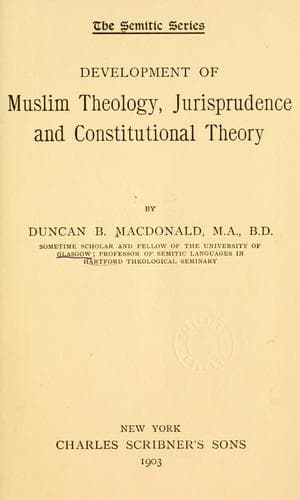
Development of Muslim Theology, Jurisprudence, and Constitutional TheoryMacDonald, Duncan Black
ReligionIslamic
Development of Muslim Theology, Jurisprudence, and Constitutional Theory
MacDonald, Duncan Black
Constitutional law (Islamic law); Islam -- Doctrines -- History; Islam and state -- History; Islamic law -- History
tone is most unpleasant, and we discover in the end that all this is
a mere preliminary discipline, leading in itself to agnosticism and a
recognition that there is nothing but vanity in this world, and that only
in the Vision of the Sufi can certainty and peace be found. So we have
again the circle through which al-Ghazzali went. As distinguished from
Ibn Rushd, the prophet, with Ibn Sab‘in, takes higher rank than the sage.
Beyond the current division of the soul into the vegetative, the animal
and the reasonable, he adds two others, derived from the reasonable, the
soul of wisdom and the soul of prophecy. The first of these is the soul
of the philosopher, and the other of the prophet; and the last is the
highest. Of the reasonable soul upward, he predicates immortality.
His position otherwise must have been practically the same as that of Ibn
Arabi. Like him he was a Zahirite in law and a mystic in theology. “God
is the reality of existing things,” he taught, and it is evident that he
belonged to the school of pantheism in which God is all, and separate
things are emanations from him. In life we have flashes of recognition
of the heavenly realities, but only at death—which is our true birth—do
we reach union with the eternal, or, to speak technically, with the
Active Intellect.
[Sidenote: END OF THE MUWAHHIDS]
Apparently it was quite possible for him to hold these views in public
so long as the Muwahhids were strong enough to protect him. But their
empire was rapidly falling to pieces and the time of freedom had passed.
An attack on him at Tunis, where the Hafsids now ruled, drove him to the
East about 643, and there he took refuge at—of all places—Mecca. The
refuge seems to have been secure. He lived there more than twenty years
amid a circle of disciples, among whom was the Sharif himself, and died
about 667. There is a poorly authenticated story that he died by suicide.
The man himself, with so many of his time and kind, must remain a puzzle
to us. For all his haughty pride of learning, it is noted of him that his
first disciples were from among the poor. His contemporaries described
him as “a Sufi after the manner of the philosophers.” The last vestige of
the Muwahhid empire passed away in the year of his death.
CHAPTER VI
The rise and spread of darwish Fraternities; the survival
and tradition of the Hanbalite doctrine; Abd ar-Razzaq; Ibn
Taymiya, his attacks on saint-worship and on the mutakallims;
ash-Sha‘rani and his times; the modern movements; Wahhabism and
the influence of al-Ghazzali; possibilities of the present.
Public-domain text, read in full here on John Shaqi.
Reviews
Reviews
No reviews yet
Be the first to share your thoughts on this work.
Elsewhere in the archive
Join the Discussion
Join the discussion
Sign in to leave a comment or review.
Sign InorCreate an account